🔴 BREAKING · SHENZHEN, THURSDAY, NOVEMBER 19, 2026
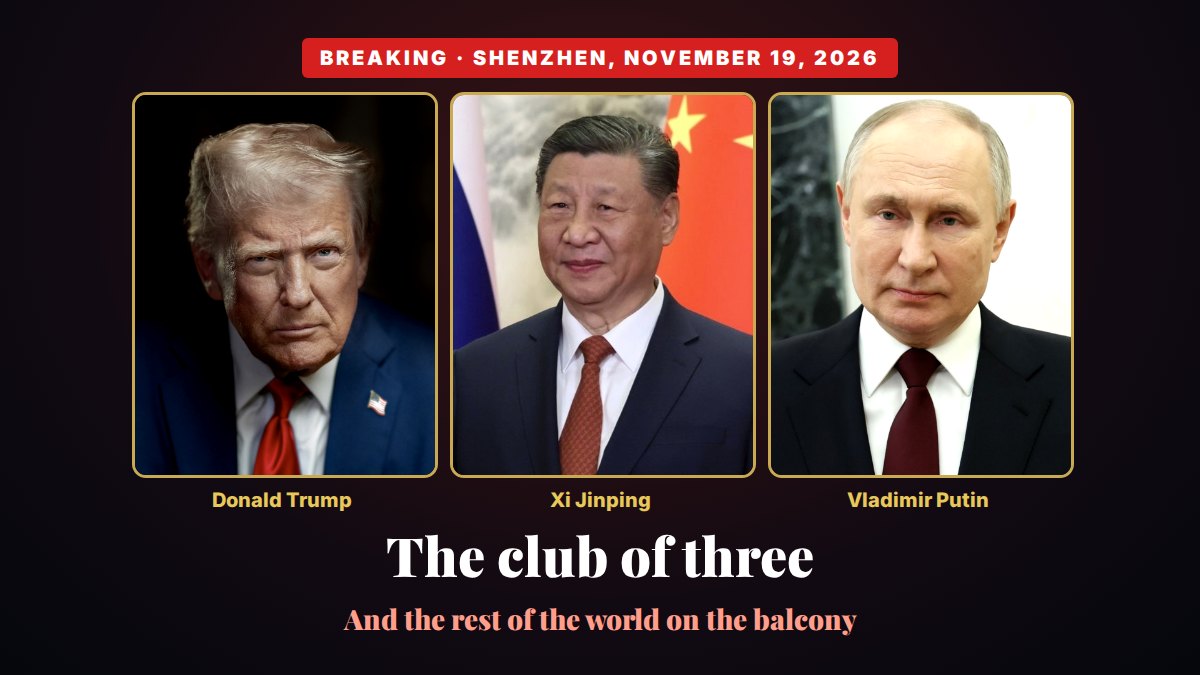
First three-way summit of Donald Trump, Xi Jinping and Vladimir Putin, on the sidelines of the APEC summit. It ended with a "Declaration toward Peace": see our update below.
Analysis by the editor-in-chief. The facts first, as confirmed this Thursday; then Jisr.media's reading, which takes a clear side: that of international law and the rights of peoples.
The picture is already in everyone’s mind. Three men around one table in Shenzhen, China’s technology showcase. Donald Trump, Xi Jinping, Vladimir Putin: together they hold the overwhelming majority of the world’s nuclear weapons, three permanent seats on the UN Security Council, and a large share of the world economy. This Thursday, they talk among themselves. The rest of the world watches.
What we know
- The summit is confirmed. China’s Foreign Ministry announced that Xi Jinping would hold a “China-Russia-U.S. Summit” with Vladimir Putin and Donald Trump in Shenzhen on November 19. The Kremlin and the White House had confirmed it earlier. It is a first.
- The setting: APEC. The meeting takes place on the sidelines of the Asia-Pacific Economic Cooperation summit, which brings the region’s leaders to Shenzhen this week.
- The agenda, according to Washington. Beijing has published nothing. According to the White House, Trump wants to discuss reducing nuclear arsenals, after the last US-Russia treaty expired in February, and the war in Iran. He is not expected to raise Russia’s war in Ukraine.
- Meetings behind the scenes. Putin and Xi met one-on-one on Wednesday. According to several media outlets, Trump and Putin also spoke on Thursday morning, before the three-way meeting.
- No deal expected. A senior US official said a breakthrough was unlikely, describing the summit as “a starting point”.
Update, 1:40 p.m. (Morocco time) · What the "Declaration toward Peace" says
After about 80 minutes, the three leaders adopted a "China-Russia-US Heads of State Declaration toward Peace", whose full text was published by Chinese state broadcaster CGTN. Four points:
- A warning to the International Criminal Court. State consent and the immunity of state officials are called paramount, and the ICC and similar bodies "must not abuse their jurisdiction".
- Nuclear arms. A nuclear war "cannot be won and must never be fought". But no arms reductions: only a "dialogue" on risk reduction and non-proliferation.
- The UN. The three permanent Security Council members pledge to "reform the UN", with no measures or timeline.
- Oil. More production and supply of refined petroleum products.
What the text leaves out: not a word on Ukraine, Iran or Gaza, nor on Europe. Xi Jinping called the meeting "positive, constructive and fruitful"; Donald Trump left without a statement. A "peace declaration" that begins by curbing international justice and shielding leaders: this is precisely the headlong rush we describe below.
Update, 7:10 a.m. (Morocco time). The Trump–Putin one-on-one did take place before the three-way meeting. According to Russia's TASS news agency, as reported by the US press, the war in Ukraine was its main topic, and Vladimir Putin left "in an excellent mood". Donald Trump praised his Russian counterpart. Ukraine, which Washington said it did not intend to raise, has thus made its way to Shenzhen, with no Ukrainian in the room. The readout of the three-way summit has not yet been published.
The club of three, or the law of the strongest
One could welcome it: three nuclear powers talking is better than three nuclear powers ignoring each other. But look at the scene more closely.
All three hold permanent seats on the UN Security Council. They could bring these issues to the organization that exists for that purpose, with its rules and every people’s right to be heard. Instead, they choose a closed room for three. Nuclear arms, Iran, perhaps Ukraine tomorrow: questions that concern the whole planet are discussed among three men, without Ukrainians, without Iranians, without the peoples of the Global South who pay the price of energy and grain with every war.
It is a headlong rush. Instead of defending international law, the great powers display their might. Instead of a multilateralism in which Senegal, Bolivia or Morocco have a voice, we return to the age of the “great powers” carving up spheres of influence. The message is clear: what counts is no longer the law, but the strength of whoever sits at the table.
"What counts is no longer the law, but the strength of whoever sits at the table."
Europe and Canada, spectators of a film they are not in
The cruelest image concerns those who thought they were at the center of the game. Europe has no seat at the table. Its leaders do not attend APEC, and European officials openly worry about a bargain struck at their expense, especially over Ukraine.
Canada’s situation is even more telling. It is an APEC member, and Prime Minister Mark Carney is in Shenzhen. He even said he would not boycott the family photo alongside Vladimir Putin. But he is not invited to the three-way summit. Canada will be in the photo, not at the table.
For Moroccans abroad, many of whom live in Europe and Canada, the scene says something about their host countries: middle powers that defended the international order and are discovering they no longer write its rules.
And what about us?
Africa is absent. So is the Arab world, even though the war in Iran directly affects Gulf security, oil prices and the daily lives of millions of families in the region. Morocco, which maintains relations with Washington, Beijing and Moscow, has no say in what is decided in Shenzhen. Like most countries in the world.
The questions Jisr.media asks this Thursday:
- Who speaks for the peoples when three powers decide among themselves on nuclear arms and wars?
- What is left of the UN if its permanent members settle the big questions outside its walls?
- Will Europe and Canada react, or resign themselves to watching?
- Will the countries of the South, Morocco and Africa among them, manage to speak with one voice to demand a multilateralism that respects everyone?
To be continued. This article will be updated once the summit's official readouts are published.
Also on Jisr.media:
FAQ
What is the Shenzhen summit of November 19, 2026?
It is the first three-way meeting between Donald Trump, Xi Jinping and Vladimir Putin, hosted by China in Shenzhen on the sidelines of the APEC summit. China’s Foreign Ministry, the Kremlin and the White House confirmed it.
What is on the agenda?
Beijing has not published an agenda. According to the White House, Trump wants to discuss reducing nuclear arsenals and the war in Iran, and is not expected to raise Russia’s war in Ukraine.
Why are Europe and Canada absent?
European countries are not APEC members, and none was invited to the trilateral. Canada is an APEC member and Mark Carney is in Shenzhen, but he is not part of the three leaders’ meeting.
What is in the Shenzhen “Declaration toward Peace”?
Four points: reform the UN; increase the supply of refined petroleum products; affirm state consent and the immunity of state officials, with the ICC told not to “abuse its jurisdiction”; and reaffirm that a nuclear war cannot be won, with only a dialogue on risk reduction. Ukraine, Iran and Gaza are not mentioned.
Sources: full text of the declaration published by CGTN on November 19, 2026; Ministry of Foreign Affairs of the People’s Republic of China, announcement of November 16, 2026 (fmprc.gov.cn); White House and Kremlin statements as reported by international media; CBC (Mark Carney at APEC); analyses by the Atlantic Council and the Brookings Institution.