Editorial analysis. It is based on the report of the House of Representatives committee on foreign affairs, national defence, Islamic affairs and Moroccans living abroad (meeting of 10 November 2026) and on Morocco's 2027 finance bill. Jisr.media takes a clear side: that of Moroccans abroad and the public interest.
THE MINISTER CONCERNED
Nasser Bourita
Minister of Foreign Affairs, African Cooperation and Moroccans Living Abroad
Born in 1969 in Taounate, a career diplomat, minister since 5 April 2017, reappointed on 16 October 2026. No party affiliation. Seven questions await him at the end of this article.
IN 30 SECONDS
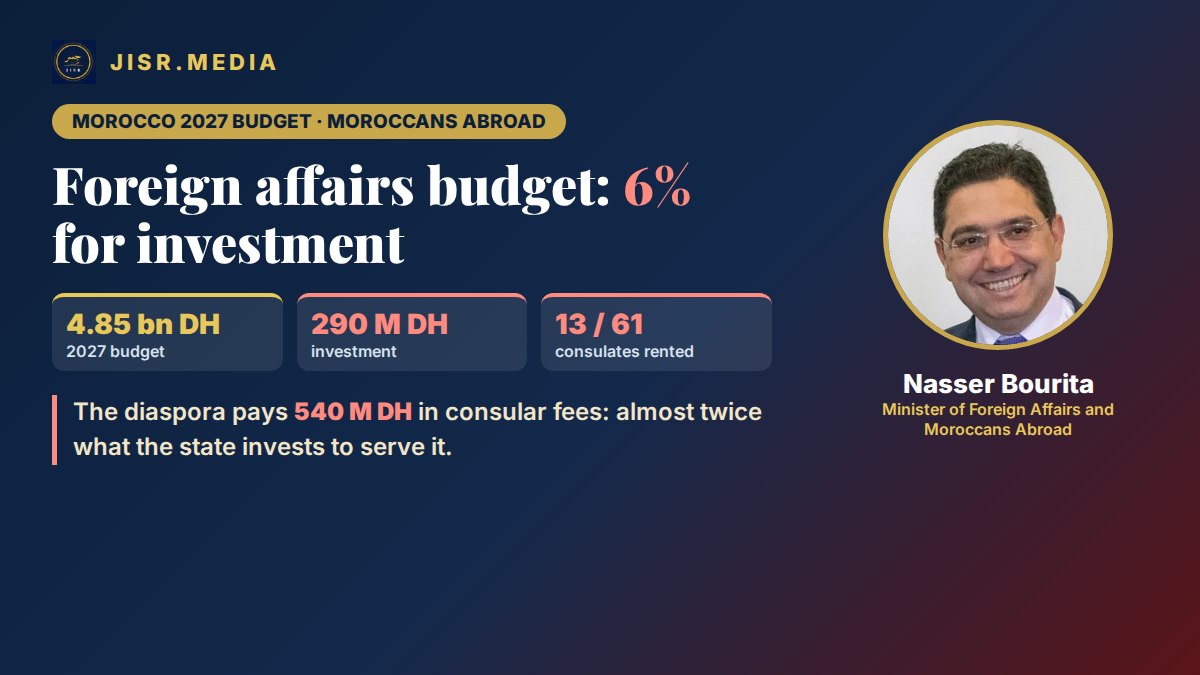
4.85 bn
dirhams for the ministry in 2027
6%
for investment: 290 million for the whole network
13 of 61
consulates still in rented premises
136 M
dirhams spent on Dar Al Maghrib in Montreal, still closed
Five and a half hours, and how many minutes for the diaspora?
On Tuesday 10 November, the foreign affairs committee of Morocco’s House of Representatives spent five and a half hours on Nasser Bourita’s budget, with 29 of its members present. The minister opened with a world in which “crisis” has become permanent: armed conflicts, non-state armed groups, organised crime in Africa, competition for energy and minerals.
He spoke at length about the Sahara, UN Security Council resolution 2797 of October 2025 and autonomy as the “exclusive option”. He spoke about the Atlantic Africa initiative, the Nigeria-Morocco gas pipeline, Palestine and Al-Quds. On these files, Morocco’s position is well known and shared by the whole committee.
Then came Moroccans abroad. According to the committee’s report, the minister gave them a short paragraph: pursuing the digitisation of procedures and relying on the “expected central role” of the Mohammed VI Foundation for Moroccans Living Abroad. For a ministry that has carried their name since 2021, that is not much.
What does the budget say?
The ministry will have 4,851,458,000 dirhams in 2027. The breakdown, as presented by the minister, speaks for itself:
3.30 bn · 68%
staff
1.26 bn · 26%
equipment and other expenses
290 M · 6%
investment
Six per cent for investment: buying premises, renovating consulates, improving reception, modernising tools. The minister himself told MPs that 48 of 61 consular premises belong to the state, and that purchases continue “as far as possible”. Thirteen consulates therefore still pay rent, often in capitals where property is very expensive.
Another telling figure: about 40% of the ministry’s staff work for the consulates. Moroccans abroad keep a large part of the house running. They also pay: 540 million dirhams in consular fees are expected in 2027, a figure cited in committee by MP Souad Frikech. That is almost twice what the ministry will invest.
Those who pay for their papers at the counter fund almost twice what the state invests to receive them.
What are MPs asking for?
On one point the committee was unanimous: more funding, more state-owned premises and more staff to keep up with the growing consular network. Majority and opposition said it together.
On Moroccans abroad, the demands are precise:
- moving beyond the seasonal approach of Operation Marhaba every summer towards a real, lasting public policy;
- finally implementing the recommendations of the 2019 fact-finding mission of the House on several consulates, which found legal problems and poor service quality;
- legal protection of property owned by Moroccans abroad in Morocco;
- direct institutional channels and their political participation, as provided for by the Constitution;
- Arabic teaching for children of the diaspora;
- faster repatriation of the remains of the deceased;
- support for the most vulnerable: low-income workers, seasonal workers, minors.
They also asked for an assessment of the impact of international agreements signed by Morocco.
What did the minister answer?
Nasser Bourita gave a few concrete updates. Criminal record certificates can now be requested remotely, after a successful pilot in Spain. The issuing of diplomatic and service passports is, he said, “governed by rules”. A Laayoune-Canary Islands shipping line is being prepared. On migration, he highlighted the regularisation of “tens of thousands” of migrants and the fight against trafficking networks.
On international agreements, his answer comes down to one idea: many of them do not fall under his ministry, and other ministries must coordinate their follow-up. No figures were given.
What the report does not say
1. What happened to the 2019 mission?
Seven years later, MPs are still asking for it to be implemented. Which recommendations were followed, and which are gathering dust? The report contains no answer.
2. When will Moroccans abroad vote?
The 2011 Constitution grants them full citizenship, including the right to vote and stand for election (Article 17). Voting from their country of residence has yet to be organised. MPs raised it; according to the report, the minister did not answer.
3. Where do consular fees go?
540 million paid by the diaspora, 290 million of investment for the whole network. How much of the fees goes back into serving users? The budget does not say.
4. Who voted for what?
The report refers the result of the vote to an annex missing from the published document. Citizens reading it cannot know who voted for this budget.
More money demanded, but by whom?
There is a contradiction worth noting. Majority MPs joined the opposition in asking for more funding for consulates and the diaspora. Yet the same groups, PAM, Istiqlal, USFP, UC and PPS, adopted on 14 November, by 179 votes to 126, the first part of the finance bill, the part that sets revenue and therefore the envelope to be shared. Asking for more in committee while voting for the framework that gives less in plenary: that is the logic to watch at the final vote.
Why this matters for our major investigations
- Royal Air Maroc and Tanger Med: the “seasonal approach” criticised by MPs is Operation Marhaba, with its summer air fares and port queues. A lasting policy for the diaspora goes through the price of travel, which we examined in our investigation into RAM (in French).
- CDG and the banks: remittances from Moroccans abroad exceed 100 billion dirhams a year according to Morocco’s Office des changes. Those who support whole families back home expect, in return, a decent welcome at the consulate.
- Local councils: protecting the property of Moroccans abroad is often decided at the municipal counter, in land disputes and planning permits.
Our five questions of 9 November: still unanswered
The day before this session, on 9 November, Jisr.media put five questions to the minister (in French), the ones our readers have been asking for a long time. The committee’s report allows us to take stock.
1. What do consular fees give back in services? No answer. The 540 million go to the state's general budget.
2. When will the life certificate be available online? No answer. The minister mentioned remote criminal record requests, not the life certificate that so many retirees depend on.
3. Who does what for Moroccans abroad, and at what cost? No answer on the total cost or on coordination between institutions.
4. After MINURSO, who reports? The minister presented the end of the UN mission as a decisive step. He did not say who will now report on the situation on the ground.
5. Dar Al Maghrib in Montreal: when will it reopen? The report does not say a word about it.
DAR AL MAGHRIB, MONTREAL: 136 MILLION AND CLOSED DOORS
Montreal's Moroccan cultural centre opened in 2012. According to Morocco's Court of Auditors, 136.32 million dirhams were delegated to the Consulate General between 2009 and 2016, for a project planned at 104 million. Floods, closures, reopenings: the centre has spent most of its life behind closed doors.
In late October, Morocco's embassy in Ottawa told us it would reopen "from early November", under the direction of Siham Mourabit. According to our sources, in mid-November the centre is still not operating. Our six questions to the consular authorities (own budget, team, state of the building, monitoring committee, role of civil society, accountability) have gone unanswered.
In five and a half hours of debate on the budget for diplomacy and Moroccans abroad, nobody mentioned the diaspora's most expensive cultural facility in Canada. Our investigation into Dar Al Maghrib (in French).
Seven questions for Nasser Bourita
1. Which recommendations of the 2019 mission on consulates have been implemented, and which are still pending?
2. How much will consular fees bring in in 2027, and what share will go to serving users?
3. Why is investment only 6% of the budget when 13 of 61 consulates are still rented?
4. When will Moroccans abroad be able to vote and stand for election from their country of residence?
5. What is the measurable record of the international agreements signed since 2017, and who is accountable for it?
6. How many diplomatic and service passports are in circulation, and on what criteria are they granted?
7. On what date will Dar Al Maghrib actually open its doors in Montreal, with what annual budget, and who will account for the 136 million dirhams already spent?
Conclusion
Moroccan diplomacy has results to show, and nobody in Parliament disputes them. But a ministry that bears the name of Moroccans living abroad is also judged at the counter: by waiting times, by a consulate’s rent, by a 2019 recommendation left without follow-up, by a cultural centre that cost 136 million and stays closed, by a right to vote still promised. On these fronts, the 2027 budget does not yet give an answer.
Your turn. Have you waited hours at a consulate, paid fees for a service that never came, or do you work in the consular network? Tell us in confidence: [email protected]. We protect our sources.
Read more on Jisr.media:
- Morocco’s 2027 budget: Souad Frikech’s questions to Nasser Bourita (in French)
- Five questions Moroccans abroad are asking minister Nasser Bourita (in French)
- Dar Al Maghrib: the reopening, and the legacy to manage (in French)
FAQ
What is the budget of Morocco’s foreign ministry in 2027? 4,851,458,000 dirhams according to the report of the House of Representatives committee: 3.30 billion for staff, 1.26 billion for equipment and other expenses, and 290 million for investment.
How many Moroccan consulates does the state own? According to the minister, the state owns 48 of 61 consular premises. About 40% of the ministry’s staff work for the consulates.
What is Dar Al Maghrib in Montreal? A Moroccan cultural centre opened in 2012. According to Morocco’s Court of Auditors, 136.32 million dirhams were delegated to the Consulate General between 2009 and 2016 for a project planned at 104 million. A reopening was announced for early November 2026; according to our sources, the centre is still not operating in mid-November.
Sources: report of the House of Representatives committee on foreign affairs, national defence, Islamic affairs and Moroccans living abroad on the ministry’s 2027 budget (meeting of 10 November 2026, rapporteur Abdelali Brouki); 2027 finance bill; intervention by Souad Frikech in committee (consular fees); Morocco’s Court of Auditors (Dar Al Maghrib); Office des changes (remittances); vote on the first part of the 2027 finance bill, House of Representatives, 14 November 2026.