Al Habsi's Notebook, No. 2
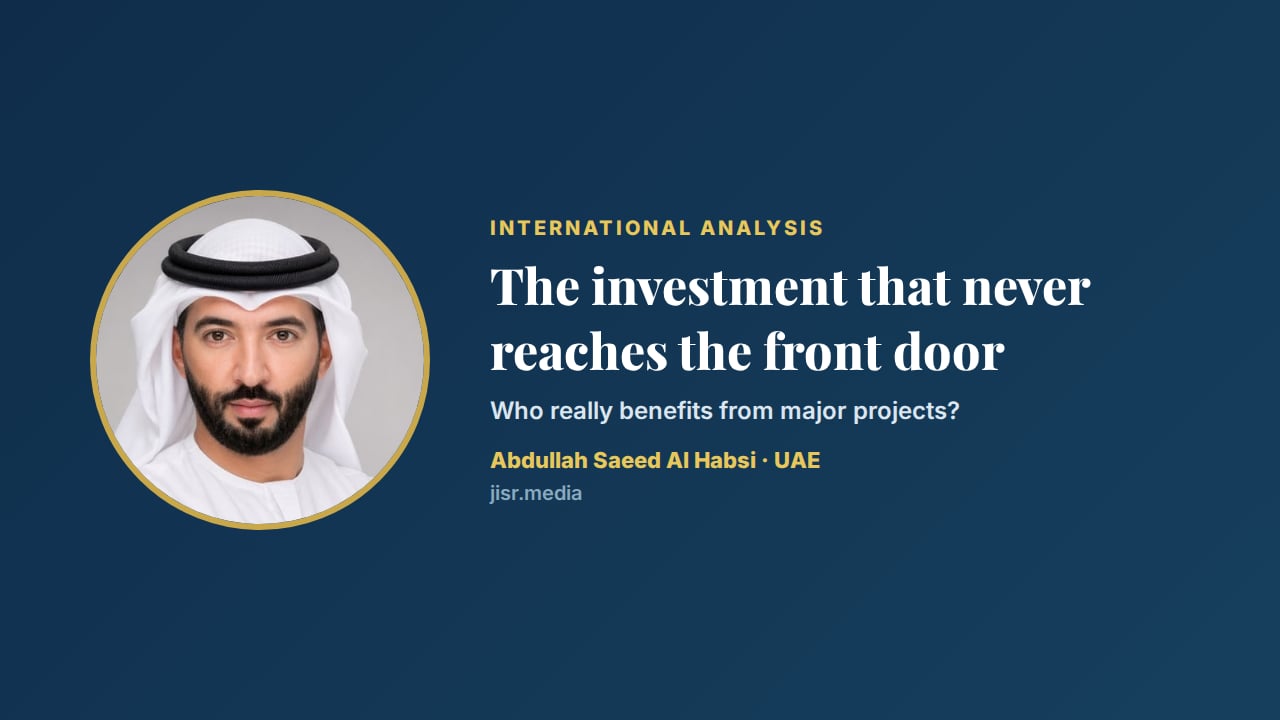
In our International analysis section, "Al Habsi's Notebook" gathers short texts by Emirati writer and researcher Abdullah Saeed Al Habsi, linked by one question: how does a decision reach people's lives? This issue brings two texts. The first is about investment that never reaches families, young people and small businesses, a timely question in Morocco, where the 2027 finance bill expects some DH 251 billion of investment by public institutions and state-owned enterprises (about US$25 billion). The second is about ports and warnings that arrive too late, starting from the network against drug trafficking announced by France on 9 November. Written in Arabic by the author for Jisr.media; translated by the Jisr.media newsroom.
1. The investment that never reaches the front door
2. Trade cannot afford late warnings
Issue 1: the sun on the roof, and who pays the price of delay in protecting people?

Congratulations!
Our contributor Abdullah Saeed Al Habsi won first prize at the Sharjah Award for Critical Research in Fine Arts 2026, for his study "From the Wisdom of Place to the Algorithm of the Image", becoming the first Emirati to win the award since it was founded. Read our congratulations
1. The investment that never reaches the front door
When a new investment project is announced, big numbers appear in the headlines, photos are taken in front of the logos, and there is talk of jobs, economic growth and a promising future. The announcement is often a legitimate reason for optimism: countries need investment that expands their economies and opens new doors to production.
But there is a question that is not asked often enough: what does that investment mean for the family living a few kilometres from the project? A father looking for work for his son does not measure success by the size of the agreement alone. A small shopkeeper does not learn the value of an investment from the press release, but from the sales that may or may not change in his neighbourhood. A graduate who has held a degree for years wants to know whether there is an opening he can apply for, and what skills he needs to get it. This is where the distance begins between investment as economic news and investment as a real change in people’s lives.
Not every big project is a big local opportunity
A large project can be built and deliver significant economic results without its benefits showing up to the same extent in the surrounding community. Some projects need specialised skills that are not available locally in sufficient numbers. Some rely on suppliers and contractors with existing business relationships. And some take a long time between the announcement and the actual start of operations.
These are not necessarily flaws in the investment, but they are facts that should be acknowledged when talking about its expected impact. The problem begins when expectations turn into general promises that lead citizens to believe jobs will arrive immediately, that small businesses will automatically find a place, and that the city will see economic improvement as soon as the agreement is signed. A project may succeed for the investor while its local impact remains limited if the necessary bridges to the community are not built.
A job does not begin on the day the factory opens
One recurring mistake is to wait until the project is complete and then ask why local young people cannot fill some of its jobs. If the facility needs technicians, supervisors and specialists in operations, maintenance and safety, preparing them should not start when the job advertisement appears.
The relevant authorities can identify expected needs from the planning stage and coordinate with schools and training centres to prepare candidates against clear requirements. But training alone is not enough. A young person asked to attend course after course without knowing how it connects to a real job may lose faith in its value. That is why clear information is needed on the skills required, the entry conditions and the possible paths to the jobs. The aim is not to promise every trainee a job, but to make sure they understand why they are training, which market they are heading for, and what genuinely improves their chances.
Small businesses are not mere spectators
A large industrial or tourism project can transform the economy around it if small firms manage to enter its supply and service chains. The project needs transport, maintenance, supplies, technical and operational services, and may need local products and support services.
But a small business owner cannot always find out about these opportunities or reach them. Registration procedures may be complex, contracting requirements unclear, or contracts too large for a single small firm to deliver. This is where economic authorities have an important role: making information accessible, explaining qualification requirements to local firms, and encouraging suitable contracting arrangements where possible.
We should not promise small businesses contracts they do not deserve or cannot deliver, but neither should opportunities to take part be confined, in practice, to firms that already know the way in. Opening the door to competition achieves nothing if business owners do not know where the door is.
"Opening the door to competition achieves nothing if business owners do not know where the door is."
An announcement is not enough to measure success
When an official announces that a project will create thousands of jobs, the public needs to know what the figure means. Is it an estimate of direct jobs during operations? Does it include temporary jobs during construction? Does it reflect genuinely new jobs, or does it include positions that will simply move from existing activities? These distinctions do not diminish the project’s importance; they help people form more realistic expectations.
Nor is it enough to count the companies that have expressed interest in investing without following how many projects actually started, how many jobs lasted, or how many local suppliers managed to take part. Monitoring should not be a way of embarrassing the investor or casting doubt on the project, but a way of improving policy and understanding the gap between what was planned and what was achieved. Figures are most valuable when they help officials correct course, not when they are used only for celebration.
Development is also measured from the window at home
Economies need large investments, just as they need infrastructure, stable legislation and an administration able to attract capital. But development is only complete when these elements turn into opportunities that people understand and can benefit from.
That may take years, and the benefits may not be shared equally between all regions or groups. This is why investment policies must be linked to paths for training, employment, local procurement and the monitoring of social impact. That does not mean placing the burden of unemployment or urban development on the investor alone. It is a shared responsibility of public policy, the private sector, educational institutions and development bodies.
When these actors work together, asking about the impact of investment becomes part of planning, not an objection raised after the celebrations are over. Citizens do not object to their city welcoming a major project, nor do they insist on benefiting personally from every investment. But they want to see a reasonable link between the promises made and the opportunities that can emerge.
Successful investment should not only reach the economy’s coffers; it should also find its way to people’s opportunities, so that residents feel the project was not merely built near them, but helped build their future.
2. Trade cannot afford late warnings
France’s announcement on 9 November of a new network of cooperation between ports to fight drug trafficking is a reminder that modern trade moves too fast for institutions to exchange warnings at leisure. Goods may travel great distances on precise schedules, but the information that protects them does not always follow the same timetable. This gap deserves attention, because it concerns not only security services, but also companies, workers and consumers.
Morocco, located on sea routes linking Africa to Europe and international markets, knows the value of a port that connects several economies. In such places, security procedures are not a mere extra line on shipping documents. They are part of the port’s reputation, the reliability of its schedules, and the confidence of investors who expect a clear explanation when something unexpected happens. Goods held up because of a real threat is understandable; goods held up because of administrative confusion is a burden that can be reduced.
More alerts do not mean more safety
In my view, the problem is not always a lack of information; sometimes we suffer from too much of it, and from the absence of order. Agencies may receive dozens of notifications, but which one requires immediate action? Which is only a remote possibility? And who has the authority to turn a warning into an inspection? If staff do not know the answers, an advanced system can become a way of multiplying waiting times instead of reducing risk. Good performance requires knowing what deserves attention and what can be followed up as normal.
Sometimes the problem is not a lack of information, but too much of it, and no order.
What interests me in the French initiative is not so much the number of participating ports as the possibility of knowledge moving between them. A shipment that passes through several stops leaves traces in its documents and its route, and no single agency can always see the whole picture. But cooperation does not succeed just because a shared platform exists. It needs mutual trust and precise rules on data quality, on what should be shared and on how errors are corrected. People and companies must be protected from suspicion that turns into a permanent verdict with no review.
Small importers pay first
I believe small business owners should have a voice in this discussion. A large company can often absorb a few days of disruption or hire a specialist team to handle shipping procedures. A small importer, however, may see essential goods held up, and lose a customer appointment or a contract it cannot afford to compensate. It is therefore only fair that the competent authorities explain procedures clearly and review whether they should continue once their reasons no longer apply, while keeping confidential what must remain so for security reasons.
Countries in the region can benefit from the UAE’s experience in developing logistics services and managing risk, but that does not mean ports must work in the same way. What matters most is a shared philosophy: reduce delays that add no protection, focus on the risks that deserve scrutiny, and involve operational teams in trials and exercises. It is useful, for example, to test what happens if an important warning arrives during a shift change, if a shipment’s data differs between two systems, or if the agency that issued the alert cannot be reached.
The algorithm does not relieve people of responsibility
With every expansion in the use of artificial intelligence, we should remember that technology does not relieve people of responsibility. An algorithm suggesting that a container be inspected is no substitute for an officer who reviews the indicators and understands the context. If false alarms keep recurring, the answer is to improve the criteria, not to get used to holding up goods in the name of caution. There must always be a way to correct and review decisions; otherwise security may become a system that people find hard to understand or to hold to account.
The French news invites us to think beyond the image of the walled-off port. A port is part of a daily relationship between countries, companies and families waiting for goods and services. The best success the new network could achieve is for warnings to arrive ahead of dangerous containers, while the road stays open for legitimate trade. Then safety does not conflict with openness; it protects it.
The best success would be for warnings to arrive ahead of dangerous containers, while the road stays open for legitimate trade.
Abdullah Saeed Al Habsi, MIoL: Emirati writer and researcher in security, heritage, risk management, leadership and control room operations; Member of the Institute of Leadership (UK).
Also on Jisr.media:
- Who takes care of the farmer when the water recedes?
- COP31 and the World We Are Preparing to Live In
- Morocco’s 3Cs: El Mansouri and Ouahbi make promises, the anti-corruption authority sounds the alarm
FAQ
Why don’t local residents always benefit from major investment projects? Because some projects need specialised skills that are not available locally, rely on existing suppliers, or take a long time to move from announcement to operation, the author writes. The local impact stays limited unless bridges are built between the project and the community.
What does the author propose? Identifying skills needs from the planning stage and working with training centres, informing small firms about supply opportunities and requirements, and tracking real results after the announcement: lasting jobs and local suppliers.
What is Al Habsi’s Notebook?
A series in Jisr.media’s International analysis section that gathers short texts by Emirati writer and researcher Abdullah Saeed Al Habsi in a single article, linked by one question: how does a decision reach people’s lives? Issue 1 was published on 14 November 2026.
What did France announce on 9 November 2026?
A new network of cooperation between ports to fight drug trafficking, to share information and warnings between participating ports.
What is the main argument of the second text?
The problem is not always a lack of information but too much of it, poorly sorted. Warnings should reach ports before dangerous containers do, while legitimate trade keeps moving.
Why does this matter for Morocco?
Morocco sits on sea routes linking Africa to Europe and international markets, and the reputation and reliability of its ports are part of investor confidence.
Who is Abdullah Saeed Al Habsi? An independent Emirati writer and researcher in security, risk management, operational resilience, leadership and control-room operations, a Member of the Institute of Leadership (MIoL), and a regular contributor to Jisr.media.
Source
- French Ministry for Europe and Foreign Affairs: diplomatie.gouv.fr