First published in French and Arabic by Jisr.media on 10 November 2026; translated by the Jisr.media newsroom.
🌍 International affairs · COP31 special
Today, Jisr.media publishes two analyses from the southern shore: Abdullah Saeed Al Habsi, from the United Arab Emirates, on the farmer forgotten after the floods, and Abdelkarim Kachouane on war and global hunger. To open the series, here are the questions the negotiators in Antalya would rather not hear.
Antalya, on Turkey’s Mediterranean coast. From 9 to 20 November, nearly 200 countries are meeting there for COP31, the 31st UN climate conference. Turkey, through its environment minister Murat Kurum, holds the presidency; Australia, through its climate minister Chris Bowen, leads the negotiations. Heads of state and government are expected on 11 and 12 November.
One COP a year, since 1995. Commitments, speeches, a family photo. And yet the figures published in recent weeks tell a different story.
31 conferences… and the planet is warming faster than ever?
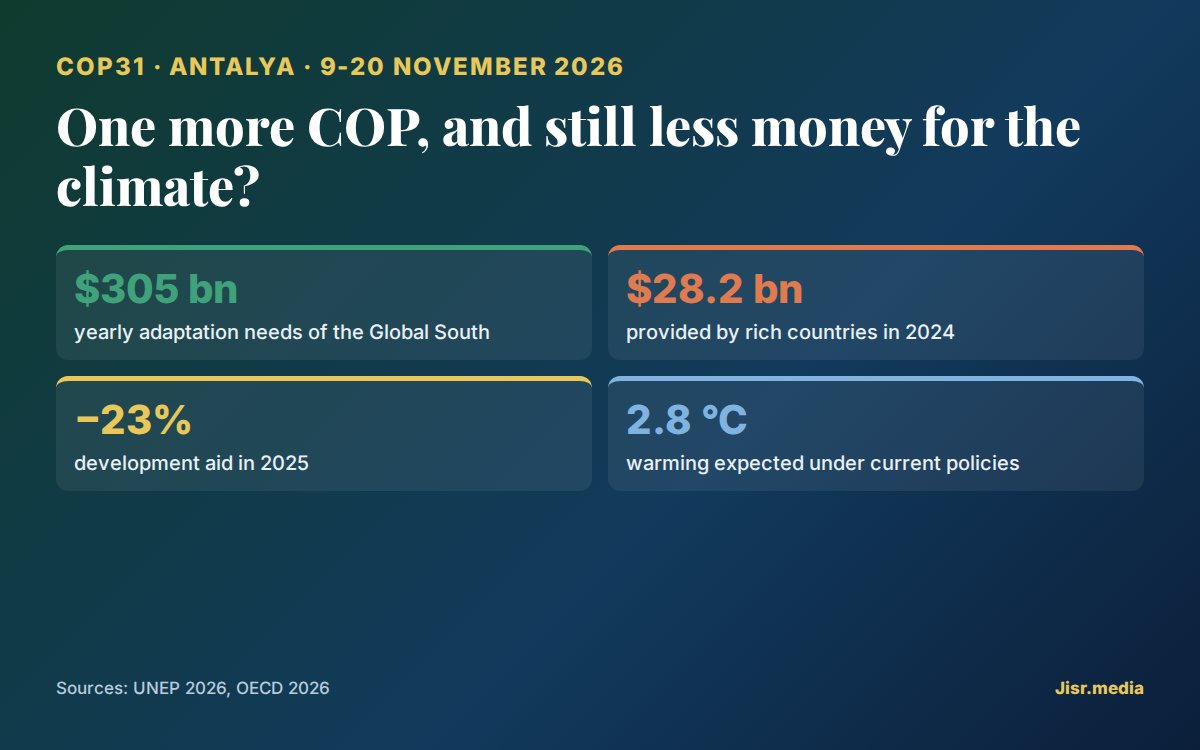
On 21 October, the UN Environment Programme (UNEP) published its annual report on the gap between promises and needs. Its verdict: under current policies, the world is heading for about 2.8 °C of warming by the end of the century. Even if every country kept every promise, warming would still reach around 2.6 °C. The 1.5 °C goal set in Paris in 2015 can no longer be met without overshooting it.
UNEP attributes part of this deterioration to one departure: that of the United States from the Paris Agreement.
Every year, we meet to observe that the goal is slipping further away.
Where has the promised money gone?
In Baku in 2024, rich countries pledged to mobilise $300 billion a year by 2035 to help countries of the South. The previous promise, $100 billion a year from 2020, was met only two years late.
On the ground, the numbers do not add up. According to UNEP’s 2026 Adaptation Gap Report, published on 4 November, developing countries need about $305 billion a year to protect themselves from droughts, floods and rising seas. Developed countries provided them with $28.2 billion in 2024. That leaves a gap of about $277 billion a year.
$305 bn
yearly adaptation needs of developing countries (UNEP)
$28.2 bn
provided by developed countries in 2024
−23%
drop in official development assistance in 2025 (OECD)
Even the goal adopted last year at COP30 in Belém, Brazil, to triple adaptation finance to $120 billion a year by 2035, would leave a gap of more than two thirds. And needs could climb to $420 billion a year by 2035. “The world is not ready to adapt to today’s climate, let alone what an overshoot of 1.5 °C will bring,” says UNEP Executive Director Inger Andersen.
Why is aid falling just as needs are soaring?
This is the most uncomfortable question. According to the OECD, official development assistance from rich countries fell by 23.1% in 2025, the sharpest drop ever recorded. The United States alone accounts for three quarters of the decline: its aid fell from about $63 billion in 2024 to less than $29 billion. But it is not alone: 26 of the 34 member countries cut their budgets, including Germany, the United Kingdom, Japan and France. The OECD expects a further decline of about 5.8% in 2026.
Humanitarian aid fell by nearly 36%. Yet it is often these budgets that pay for rebuilding after a flood or for supporting farmers hit by drought.
You cannot promise $300 billion for the climate with one hand and cut aid with the other.
Are rich countries paying their climate debt?
Warming does not depend on a single year’s emissions, but on all the CO2 accumulated since the industrial revolution. According to calculations by the specialist website Carbon Brief, the United States alone has emitted about one fifth of cumulative CO2 since 1850. The whole of Africa has emitted less than 3%.
Yet it is the countries of the South that suffer most: repeated droughts in the Maghreb and the Sahel, floods in Pakistan, Libya and the Gulf, cyclones in the Pacific. The principle has been written into UN texts since 1992: common but differentiated responsibilities. In practice, yesterday’s biggest polluters are the slowest to pay.
A COP without the United States: what’s the point?
Washington is not negotiating in Antalya: the United States has left the Paris Agreement. Only a delegation of 19 members of Congress, with no mandate, is making the trip to keep in touch. The planet’s largest historical polluter is therefore watching the conference from afar.
The question also applies to everyone else: is a COP that adopts goals without a binding timetable or sanctions still a place where decisions are made, or just a place where people meet?
And where does Morocco fit in?
Morocco, host of COP22 in Marrakech in 2016, knows what climate change costs: years of drought, dams running dry, and a farming sector that supports millions of families and is suffering. The country is investing in desalination and renewable energy, often with its own resources.
For Moroccans abroad, too, the question is concrete: it is their parents’ village, the family harvest, the price of vegetables at the souk. As Abdullah Saeed Al Habsi writes today, recovery is not measured by roads reopening, but by the day the field produces again.
The questions we are asking in Antalya
- Why is development aid falling just as disasters are multiplying?
- When will the $300 billion promised in Baku actually be paid, and in what form: grants, or loans that add to poor countries’ debt?
- Who pays for the adaptation of small farmers, in the Maghreb, in Africa and elsewhere?
- Will the countries responsible for most past emissions accept a binding timetable?
- What is a global agreement worth without the largest historical polluter?
Jisr.media will follow the conference until 20 November. And you, what do you expect from COP31? Write to us in English, French or Arabic: [email protected]
Write for Jisr.media
Researchers, writers and journalists from Morocco, Algeria, the Gulf, Iran and beyond: our pages are open to your analysis and opinions, in English, French or Arabic, with a right of reply.
Also on Jisr.media:
- Who takes care of the farmer when the water recedes? (Abdullah Saeed Al Habsi)
- Iran, Palestine and Ukraine: the role of French diplomacy for peace and human dignity
- War and the global food security crisis (Abdelkarim Kachouane) (in French)
- Gaza: displaced families’ tents flooded after the 7 November storms (in French)
- The original version in French · and in Arabic
FAQ
When and where is COP31 taking place?
In Antalya, Turkey, from 9 to 20 November 2026. Turkey presides over the conference and Australia leads the negotiations. The leaders’ summit takes place on 11 and 12 November.
How much money is missing for climate adaptation?
According to UNEP’s 2026 report, developing countries need about $305 billion a year. Developed countries provided $28.2 billion in 2024, leaving a gap of about $277 billion a year.
Is aid from rich countries increasing?
No. According to the OECD, official development assistance fell by 23.1% in 2025, the sharpest drop ever recorded, and a further decline of about 5.8% is expected in 2026.
Is the United States taking part in COP31?
Not in the negotiations: it has left the Paris Agreement. A delegation of 19 members of Congress, with no negotiating mandate, is nevertheless travelling to Antalya.
Why single out rich countries as responsible?
Because warming depends on cumulative emissions since the industrial era. The United States alone has emitted about one fifth of them since 1850, while the whole of Africa, which suffers droughts and floods, has emitted less than 3%.
Sources
- UNEP, Adaptation Gap Report 2026 (4 November 2026) and Emissions Gap Report 2026 (21 October 2026).
- OECD, preliminary data on official development assistance 2025 (9 April 2026).
- Carbon Brief, analysis of cumulative historical CO2 emissions (1850-2021).
- UNFCCC, official COP31 programme.