Al Habsi's Notebook, No. 1
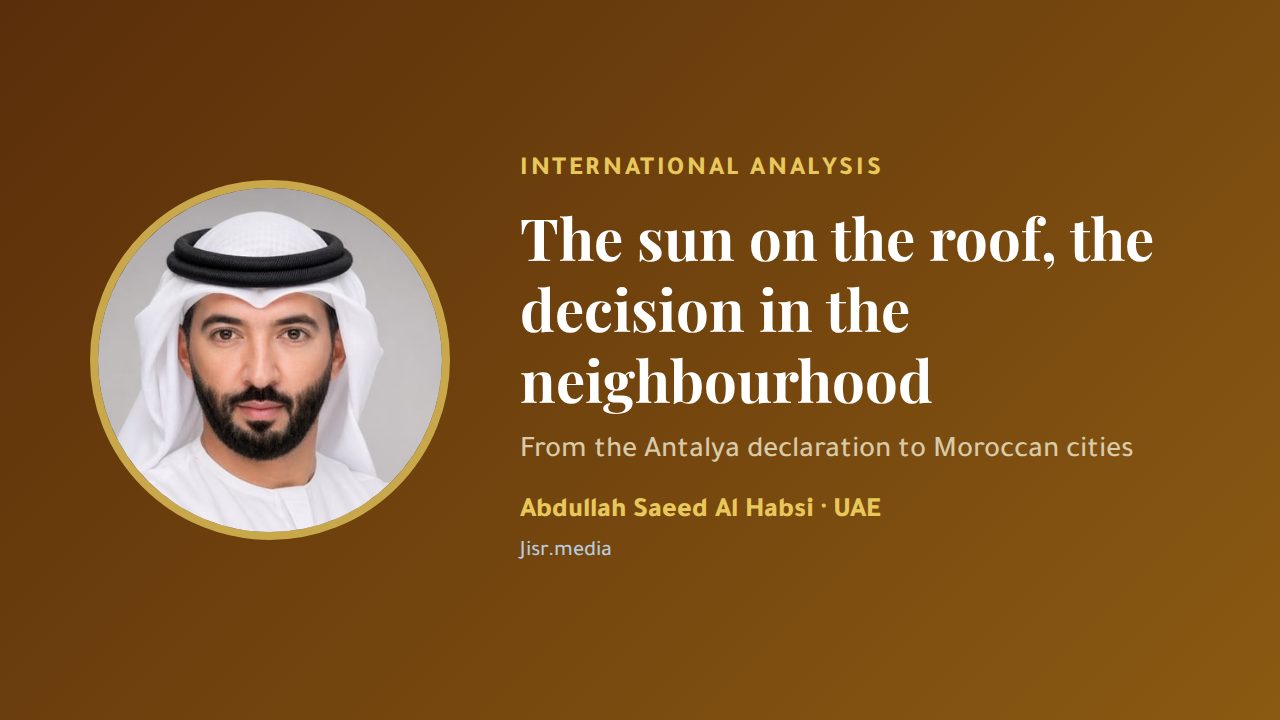
In our International analysis section, we are opening "Al Habsi's Notebook": short texts by Emirati writer and researcher Abdullah Saeed Al Habsi, gathered in a single article and linked by one question: how does a decision reach people's lives? This first issue brings together two texts written during the COP31 climate conference in Antalya. Originally written in Arabic; translated by the Jisr.media newsroom.
Update · Congratulations!
Our contributor Abdullah Saeed Al Habsi won first prize at the Sharjah Award for Critical Research in Fine Arts 2026, for his study "From the Wisdom of Place to the Algorithm of the Image", becoming the first Emirati to win the award since it was founded. Read our congratulations
1. The sun on the roof, the decision in the neighbourhood
Putting solar panels on the roof of a house may seem a simple engineering matter, but this week’s news from the climate conference in Antalya opens a much wider door. A group of countries endorsed a voluntary declaration that aims to raise the number of homes using rooftop solar from about 150 million to 300 million by 2030. The figure is attractive, but on its own it does not answer the question that matters to residents: how does a technical project become a stable service that people trust, and how are its benefits shared between neighbourhoods?
In Morocco, the discussion does not start from scratch. The country has experience with renewable energy projects, abundant sunshine, and cities whose buildings and household incomes vary widely. But putting panels on the roofs of homes is different from building a large power plant far from where people live. Here we face thousands of small decisions: an owner comparing costs, a family thinking about maintenance, an old neighbourhood worried about its roofs, and a municipality trying to understand what should be licensed and what should be monitored. The value of the idea is decided in these details.
The consumer’s right to clear information
I believe the first step is for citizens to know what they are actually buying. Announcing the expected amount of electricity is not enough unless they are told the hours of production, the cost of replacement, the realistic lifespan of batteries in use, and who to turn to if the system breaks down. Some marketing offers present solar energy as complete independence from the grid, while the reality depends on how the system is designed, connected, and whether it needs storage. This is not a criticism of the technology, but a defence of the consumer’s right to a decision based on clear information.
The poorest neighbourhood should not be the last to benefit
Then there is the question of fairness between neighbourhoods. The roofs of new buildings may be easier to equip than crowded houses or old buildings that need a structural inspection. If incentives are limited to those with money and space, the gap between households may widen instead of narrowing. Municipalities and funders can design options suited to apartments, housing complexes and shared facilities, provided that programmes start with a real assessment of needs and explain clearly to citizens the limits of the support. What matters is that the least well-off neighbourhood is not the last to benefit.
What matters is that the least well-off neighbourhood is not the last to benefit.
Old houses in Morocco have another value that does not always appear in investment tables. The roof is part of the architecture and of the visual memory of a place, and any installation may need solutions that respect the building, safety requirements and the look of the area. Here the energy engineer must sit alongside the heritage specialist and the municipality, rather than one of them arriving once the work is done to ask how the landscape changed. The success of the transition is also measured by our ability to preserve the character of cities while we modernise their services.
Reliability before photo opportunities
From my experience in risk management and operations, I believe reliability deserves a clear place in any programme. What happens if an inverter stops working on the hottest day of the year? Does the homeowner know who to call? Are there spare parts and qualified technicians? What are the safety procedures in case of fire or during maintenance? These questions can be answered at the design and training stage. Leaving them until after an incident turns the expected gain into a new source of worry.
The United Arab Emirates offers an important regional example of large-scale investment in clean electricity, but the useful comparison is not the number of projects or the photographs published about them. What is worth sharing between the UAE and Morocco is practical experience in regulation, inspection, technician training and communication with beneficiaries. The success of a solution is not determined by abundant sunshine alone, but by the ability of institutions to turn a natural resource into a daily service that can be maintained and held to account.
The Antalya declaration remains a voluntary promise that needs policies, funding, skills and electricity grids able to absorb the new supply. It is better treated as such, not as a decision guaranteeing that panels will reach every roof. When Moroccan cities discuss this future, I hope the question will start from the neighbourhood itself: who will benefit, who will provide the service, and how will we know, years from now, that people’s lives have become better? Only then will the transition leave the conference hall and reach the home.
Only then will the transition leave the conference hall and reach the home.
2. Who pays the price of delay in protecting people?
A long meeting can end with an excellent decision, but the decision is not worth much if it arrives after a family has lost what it was waiting to have protected. This idea is not only about the climate; it is about the way we look at people as they wait behind the figures, the plans and the committees.
On 14 November 2026, the UN climate chief Simon Stiell, speaking at the COP31 conference in Antalya, called for faster progress on the difficult files and for climate action to come closer to people’s daily lives. It is a message worth reading from a simple angle: who pays for the time we waste before we act?
Who really pays for the wait?
When the repair of a road that floods every season is delayed, the one who suffers is not the report left in an office drawer. It may be a worker who loses a day’s wage, a patient who is late for an appointment, or a mother who walks a longer way to take her children to school. And when the problem keeps coming back, small losses turn into a daily burden that never fully appears in any official record.
Imagine a neighbourhood whose residents know that heavy rain cuts off one of its entrances. They report it, specialist teams visit the site, and recommendations are sent up that need a budget or the approval of several bodies. The procedures may be necessary, but one question remains unanswered: what do we do to protect people until the permanent fix is complete?
What do we do until the full fix arrives?
A temporary plan can divert traffic, provide transport when needed, or set up a clear contact point to receive reports. These measures do not solve the problem at its root, but they acknowledge that citizens cannot put their lives on hold until the exchange of letters is over.
On climate issues we often hear about plans that stretch over years, about funding, technologies and huge projects. All of that matters. But a family facing an extremely hot day needs guidance and services it can rely on now. And a shopkeeper whose business suffers from the loss of an essential service needs honest information about when it will be back, not promises for which no one knows who is responsible.
Do people know what to do?
This is why our question must change from “Do we have a plan?” to “Do people know what to do, who will help them, and when help will arrive?” An institution may have a detailed plan, but poor communication makes it as if it did not exist. Conversely, a clear and honest explanation can ease some of the anxiety even when an immediate solution is not possible.
Nor should we put all the blame on the employee standing in front of the public. That employee may know how serious the problem is and want to help, but lack the authority or the resources. Fairness requires us to look at the whole chain of decision: who received the report, who assessed the risk, who has the power to act, and what happens if the decision-maker is absent or busy with another file.
Practical steps for every institution
Every institution can start with practical steps. It can identify the recurring problems that affect people’s lives, set a clear response time for them, and provide an alternative escalation route when the usual one breaks down. And after every incident, it can review not only how fast it responded, but whether the service actually reached the families who needed it most.
Sometimes an institution’s speed is measured by the number of files it has processed, while we do not know how many days citizens spent waiting. That difference deserves attention, because real administrative success is not paper moving between offices, but the effect of the decision outside them.
Real administrative success is not paper moving between offices, but the effect of the decision outside them.
I am not calling for hasty decisions or for bypassing the procedures that protect public money and people’s safety. I am calling for caution not to become an excuse for letting small harms pile up until they turn into a crisis. What can be done now should not be postponed simply because the complete solution is not yet ready.
In the end, citizens do not care much how many meetings we held to discuss the danger, but what has changed on the road they take, in the service they need and in the safety they feel. And I fear that sometimes the heaviest price people pay is not the cost of the problem itself, but the cost of the delay in admitting that it deserves a solution.
Sometimes the heaviest price people pay is not the cost of the problem itself, but the cost of the delay in admitting it deserves a solution.
Abdullah Saeed Al Habsi, MIoL: Emirati writer and researcher in security, heritage, risk management, leadership and control room operations; Member of the Institute of Leadership (UK).
Write for Jisr.media
Researchers, writers and activists from Morocco, the Maghreb, the Gulf and beyond: our International analysis section is open to your analysis and opinion, in English, French or Arabic, with a right of reply.
FAQ
What is the Antalya rooftop solar declaration?
A voluntary declaration endorsed by a group of countries at the COP31 climate conference in Antalya, aiming to raise the number of homes with rooftop solar from about 150 million to 300 million by 2030. It is not a binding agreement.
What is the author’s main argument?
The value of rooftop solar depends not only on sunshine, but on institutions able to turn it into a clear daily service, fair between neighbourhoods, that can be maintained and held to account.
What does the author suggest for Morocco?
That citizens know what they are buying, that incentives are not limited to those with money and space, that installations respect old houses, and that maintenance and safety are part of the design.
What is Al Habsi’s Notebook?
A series in Jisr.media’s International analysis section that gathers short texts by Emirati writer and researcher Abdullah Saeed Al Habsi in a single article, linked by one question: how does a decision reach people’s lives?
Who pays the price of delay in protecting people, according to the author?
Citizens first: the worker who loses a day’s wage, the patient who misses an appointment, the mother who walks further. He therefore proposes temporary measures, clear response times, an alternative escalation route and honest communication.
Who is Abdullah Saeed Al Habsi?
An independent Emirati writer and researcher in security, risk management, operational resilience, leadership and control room operations, a member of the UK Institute of Leadership (MIoL), and a contributor to Jisr.media.
Also on Jisr.media:
- COP31 and the World We Are Preparing to Live In
- COP31 in Antalya: one more conference, and still less money for the climate?
- Who takes care of the farmer when the water recedes?
Sources
- Global Solar Council, Global Rooftop Solar Declaration at COP31, 10 November 2026: globalsolarcouncil.org
- UNFCCC, communications of Executive Secretary Simon Stiell: unfccc.int