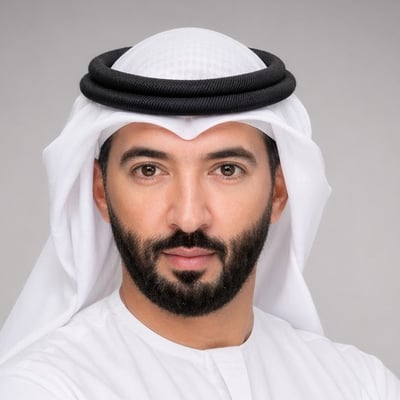
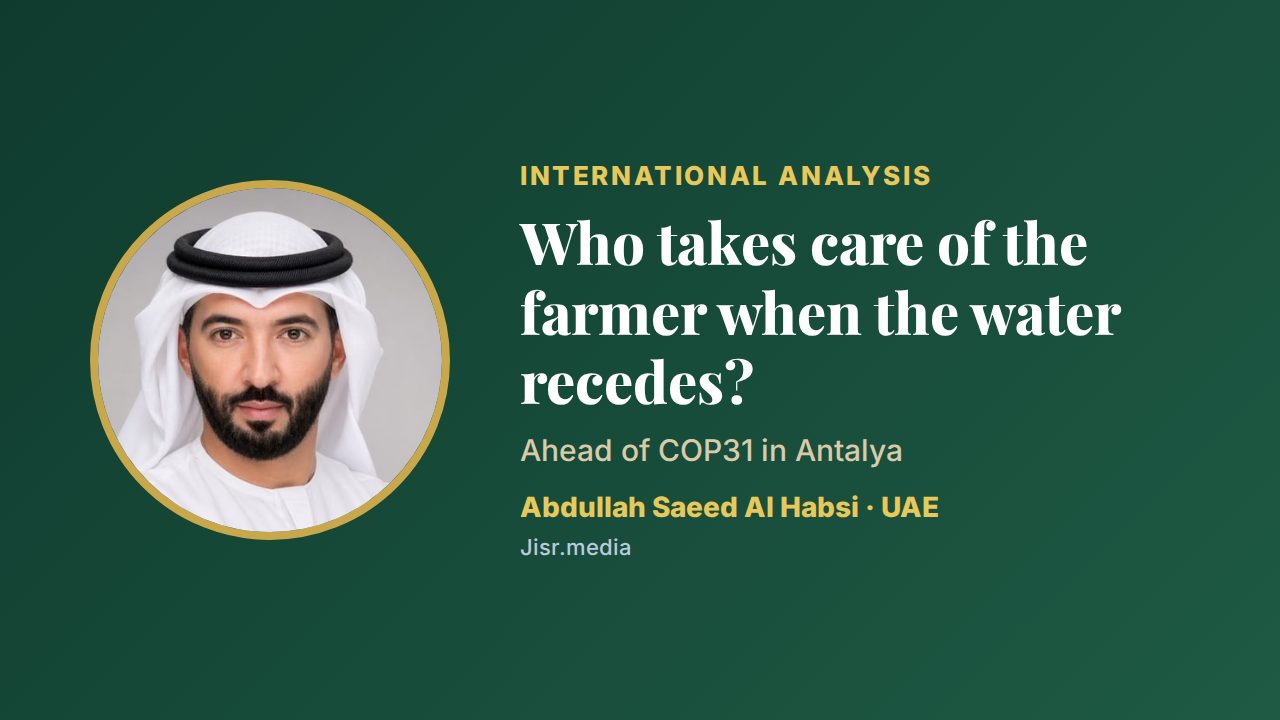
In our International analysis section, Emirati writer and researcher Abdullah Saeed Al Habsi returns, as the COP31 climate conference opens in Antalya, with a question that tends to vanish once the cameras leave: who takes care of the farmer when the water recedes? Originally written in Arabic; translated by the Jisr.media newsroom.
On the news, a flood usually ends when the water recedes and the roads reopen. In farming villages, that is often when the hardest part begins. The farmer who returns to his land does not only see the mud piled up. He sees lost seeds, damaged tools, debts coming due, and working days that no passing image on the evening news will ever give back.
This is not to deny the importance of rapid rescue or the efforts of emergency teams. Survival remains the first priority. But real safety is not complete when people get back home. It depends on their ability to resume their lives without a single disaster turning into years of hardship.
COP31: the question of “what do we do tomorrow?”
As COP31 opens in Antalya, there is renewed talk of adaptation, finance and resilience. These words matter in international conference rooms, but they sound different to a smallholder, to a seasonal worker who has lost his wages, or to a woman whose home business stopped because the road was cut. They do not usually ask for the name of the adaptation programme. They ask the more immediate question: what do we do tomorrow?
The response usually starts with a general plan for the affected areas. Yet within a single area, losses are not alike. The owner of a large farm can buy a new pump; his neighbour cannot afford to repair his irrigation channel. Aid may reach the landowner, while the day labourer paid by the day never appears in the damage reports. And there are families without complete paperwork who still lose their only source of income.
Recovery means getting back to work, not just rebuilding
Recovery should therefore be thought of as getting back to work, not only as restoring buildings to how they were. If the school reopens but children cannot reach it, education has not returned to normal. If the bridge is repaired but the market where the farmer sells remains closed, economic activity has not recovered. If the farmer receives new seeds without knowing when the water will arrive or whether the distribution network is ready, he may face a second loss.
This is where combining local knowledge with institutional decision-making proves its worth. Villagers know the slopes where water gathers, the old footpaths, and the land that takes longer to dry. This knowledge is no substitute for engineering measurements and scientific maps: accounts may differ, and some old paths are no longer safe. But it raises precise questions that officials and engineers should test before approving a new project.
Nor should the role of associations and agricultural cooperatives begin with aid distribution and end with the photo. They can take stock of damaged shared equipment, organise group purchases to lower costs, help farmers keep simple records of their losses, and check whether aid reached those in most urgent need.
Making big promises and then leaving people without an answer for months destroys trust more than a modest but clear programme.
Honesty before promises
Recovery also requires honesty about what the state or donor can actually provide. Making big promises and then leaving people without an answer for months destroys trust more than a modest but clear programme. When a realistic timetable is announced and a channel for questions and appeals is opened, families can plan their decisions, even if resources fall short of their needs.
Conversely, not every delay is proof of neglect. Repairing dams, roads and water networks may require technical inspections, funding and tenders, and returning too quickly to a damaged site can be more dangerous than waiting. The point is not to cut corners on safety, but for people to understand the reason for a decision, what is being done, and when the authorities will get back to them.
I also believe the media can offer a greater service than simply recording the scale of destruction. It would be useful to return to the villages one month and three months later, to compare promises with reality, and to ask the worker, the farmer and the student what has changed. Coverage would then move from a moving scene to a collective memory that helps improve the next response.
A simple test everyone understands
The international conference may end with agreements and recommendations, and countries may disagree on funding priorities. But there is a simple test everyone understands: is the person who was exposed to the risk better able to face the next one? The number of projects announced or meetings held is not an answer. The answer can be seen in the field that is producing again, the road that stayed open, and the family that did not have to sell what it owns to start from scratch.
When the water recedes, the story is not over. One person is waiting for seed, another for a wage, and a third wants to hear from the responsible authority what will happen next. If we want climate adaptation to mean something in people’s lives, we must remember them after the cameras are gone.
Finally, the assessment should not stop at asking families what they lost. We should ask them what they need to regain their ability to earn a living, and distinguish temporary compensation from investment that prevents the loss from happening again. Repairing an irrigation channel that serves dozens of farmers may do more good than short-term aid that changes nothing about working conditions. In other cases, direct aid is an urgent necessity that cannot wait, especially for families who have lost food, medicine or shelter. There is no one-size-fits-all recipe, which is why field assessment, listening to those directly affected, and reviewing results after implementation matter, rather than settling for announcing the initiative.
If we want climate adaptation to mean something in people's lives, we must remember them after the cameras are gone.
Abdullah Saeed Al Habsi, MIoL: member of the UK Institute of Leadership, independent Emirati writer and researcher specialising in security, leadership, risk and operations rooms.
Write for Jisr.media
Researchers, writers and journalists from Morocco, Algeria, the Gulf, Iran and beyond: our pages are open to your analysis and opinions, in English, French or Arabic, with a right of reply.
FAQ
Why does the story not end when the water recedes?
Because farmers face lost seeds, damaged tools and debts, and day labourers often do not appear in damage reports.
How does this relate to COP31?
The author writes as COP31 opens in Antalya and asks that adaptation and resilience translate into concrete results.
What role does local knowledge play?
It raises precise questions for engineers and officials, without replacing scientific measurement.
Who is Abdullah Saeed Al Habsi?
An independent Emirati writer and researcher, member of the UK Institute of Leadership, and a contributor to Jisr.media.
Also on Jisr.media: