In our International analysis section, Emirati writer and researcher Abdullah Saeed Al Habsi returns while COP31 is under way in Antalya, with a question that outlasts every closing ceremony: what will still work when the delegates have gone home? Original commentary written in English for Jisr.media.
From climate promises to reliable public services, resilient institutions and human dignity
There is a particular kind of silence that follows a major international conference. The speeches have ended, the photographs have been published, and the delegations have returned home. The final declaration has been praised, criticised and eventually replaced by another headline. For the people whose lives were discussed during those negotiations, however, very little may have changed.
A farmer still watches the sky and wonders whether the next season will provide enough water. A family living near a vulnerable coastline still considers what it might lose in the next severe storm. A hospital administrator still worries about maintaining electricity during extreme heat. An emergency manager still knows that a warning, however accurate, matters only when somebody has the authority and resources to act upon it.
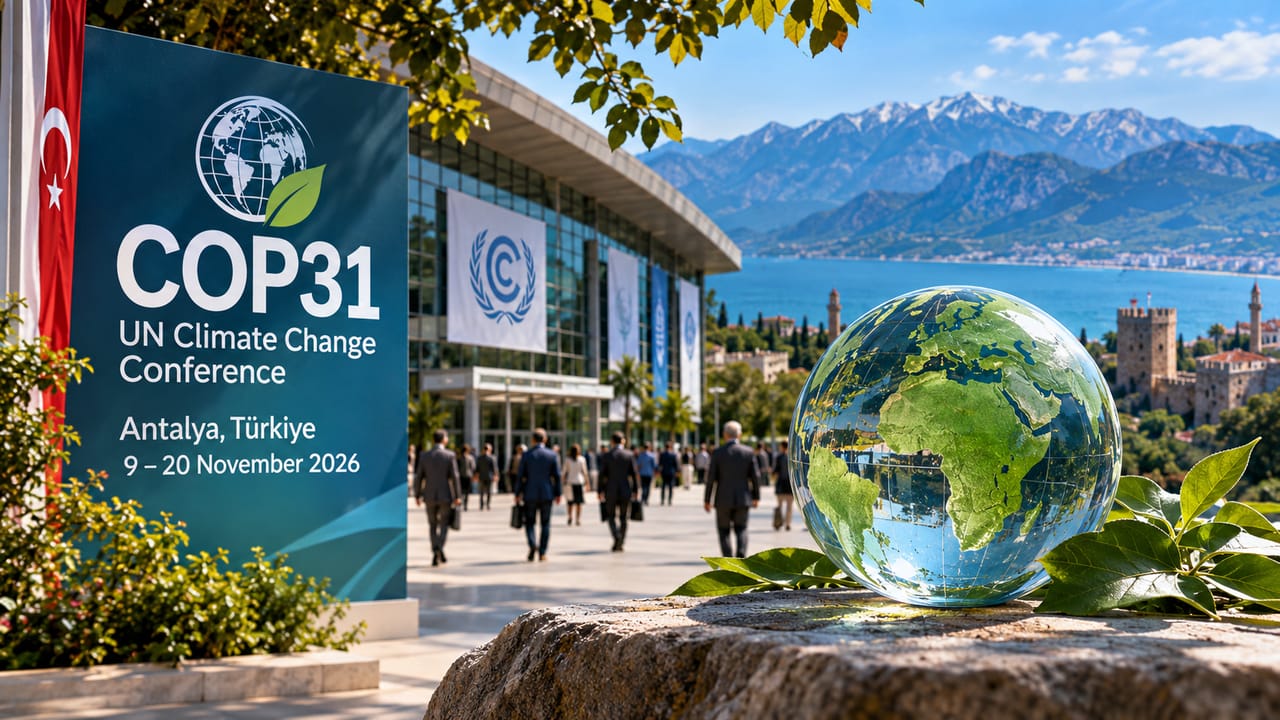
These are the people who should occupy the centre of our thinking as the world gathers for COP31 in Antalya, Türkiye. The thirty-first United Nations Climate Change Conference opened on 9 November 2026 and is scheduled to continue until 20 November. Türkiye hosts and presides over the conference, while Australia presides over the formal negotiations. That unusual division of responsibility is itself a reminder that meaningful cooperation sometimes requires countries to share authority rather than compete for every part of a process.
Yet the conference’s value will not be measured by the elegance of its arrangements. It will be measured by what governments, cities, businesses and communities can do when the delegates have gone home.
The climate crisis has become a test of government
Climate change is often described through global figures: average temperatures, atmospheric concentrations, emissions pathways, investment requirements and targets for future decades. These figures matter. Without scientific measurements, policymakers would struggle to understand the scale and direction of the problem. But climate risk is not experienced as a global average. It arrives at a particular address.
It reaches a road, neighbourhood, school, farm, port or power station. It affects a family that cannot afford to repair its home, an elderly person who depends on reliable cooling, or a worker whose journey has become dangerous because of extreme weather. This distinction changes the question facing governments. The issue is no longer simply whether a country accepts that climate change is serious. The more demanding question is whether its institutions can translate that understanding into dependable public services.
A government may possess sophisticated forecasting systems and still struggle to protect vulnerable communities. It may establish ambitious renewable-energy targets while neglecting maintenance across the electricity network. It may invest heavily in technology while leaving emergency-response responsibilities divided between agencies. Such contradictions arise when climate policy becomes a collection of separate projects rather than a responsibility extending through the machinery of government.
In my view, climate readiness deserves the same seriousness as national security, public health and economic continuity. Who receives an early warning? Who checks that it reaches the people at risk? Who can close a road, mobilise a medical team or arrange temporary accommodation? What happens when different agencies receive conflicting information? How does a community function when electricity, communications and transport fail together? These questions are less impressive than announcing a new global target. They are also much closer to the difference between a manageable incident and a national emergency.
Climate risk is not experienced as a global average. It arrives at a particular address.
The distance between a promise and a working system
The international climate process has produced important agreements, scientific assessments, financing mechanisms and national commitments. Those achievements deserve recognition. Countries need common objectives and institutions in which they can negotiate difficult responsibilities. Nevertheless, a commitment made at a conference does not automatically become a working system.
Consider the expansion of renewable electricity. On 10 November, supporters of the voluntary Global Rooftop Solar Declaration endorsed an ambition to increase the number of homes equipped with rooftop solar worldwide from roughly 150 million to at least 300 million by 2030. It is a significant proposal, and an encouraging illustration of how climate ambition can connect to household concerns. Distributed solar generation can improve access to electricity and reduce bills. With appropriate storage and design, it may also support resilience when central networks are disrupted.
But the declaration is voluntary, not a binding global agreement. And a rooftop system is only as useful as the arrangements supporting it. A household needs suitable equipment, competent installers, safe connections, reasonable financing and dependable maintenance. A national system needs technical standards, grid capacity and a plan for periods when generation falls. Rapid installation without sufficient training can create risks of its own. A programme that excludes lower-income households can widen inequality even as national capacity grows.
This is not an argument for lowering ambition. It is an argument for treating ambition as an engineering, social, economic and institutional undertaking. The number of installations is important. The number of households receiving reliable, safe and affordable electricity is more important. The same distinction applies to flood defences, water systems, urban cooling, agricultural adaptation and public transport. A project becomes meaningful when it continues to work under difficult conditions.
Where people live is where resilience begins
International negotiations naturally focus on countries. Climate impacts, however, are often managed first by municipalities, neighbourhoods and local institutions. A coastal city may understand the long-term risk of storms and rising seas, yet responding effectively requires a much more detailed picture. Which streets become inaccessible first? Which hospitals depend on vulnerable access routes? Where are residents who cannot evacuate without help? Do local authorities know which households have limited access to digital warnings?
A heatwave produces equally practical questions. Are outdoor workers protected? Can schools adjust schedules when necessary? Are cooling spaces accessible to people who cannot afford sufficient air conditioning? Can the electricity network maintain essential supply during peak demand? A climate-resilient city is not necessarily the one with the most impressive technology. It is the one that understands its vulnerabilities and gives its institutions the capacity to respond.
Residents themselves hold useful operational knowledge. They know which road floods after heavy rain, which neighbourhood receives warnings too late, and which services are least reliable during emergencies. Their experience should be treated as an important source of evidence, to be tested and combined with scientific data, not dismissed as anecdote. Engineers, emergency managers, healthcare professionals, teachers and local organisations hold different pieces of the same picture. Effective resilience brings those pieces together before an emergency occurs.
The objective is not to predict every disaster. It is to reduce confusion when predictions become reality. A modest but well-rehearsed local response plan can be more valuable than an expensive system that nobody knows how to operate.
What the Gulf can contribute
For Gulf states, climate discussions carry particular significance. The region faces intense heat, constraints on water resources, pressures on energy demand and the challenge of protecting essential services in a demanding environment. At the same time, Gulf economies have invested extensively in infrastructure, logistics, technology and urban development. This combination creates responsibilities and opportunities.
The United Arab Emirates, which hosted COP28 in Dubai in 2023, has pursued renewable-energy development and infrastructure modernisation alongside economic diversification. These priorities are not automatically free from tension. Every transition involves choices about technology, investment, industrial development and the pace at which existing systems can change. What matters is the ability to manage these choices responsibly, with attention to both environmental objectives and service continuity.
From my perspective as an Emirati writer and researcher concerned with security, risk management and operational resilience, one of the Gulf’s most useful contributions could be a stronger emphasis on the reliability of critical infrastructure. Extreme heat affects more than comfort. It influences electricity demand, transport, industrial operations, workforce safety and equipment performance. Water security involves production, storage, distribution, conservation and the ability to maintain services when part of a system is disrupted.
Countries operating complex infrastructure in difficult climates have lessons to share, but they also have much to learn. African communities offer experience in decentralised electricity and adaptation under resource constraints. Pacific island states offer an urgent understanding of how climate threats can affect land, identity and continuity. Communities in different regions have developed ways to manage drought, floods and coastal exposure. International cooperation should allow knowledge to move in every direction.
Leadership in this field is not just a matter of financial capacity or the number of projects announced. It is the willingness to share what works, acknowledge what fails and make useful practices accessible to others.
Climate finance is also a question of trust
Few subjects at climate conferences are as difficult as finance. Countries differ in historical emissions, economic capacity and exposure to harm. A vulnerable country may understand exactly what it needs to protect its coastline, modernise its electricity network or improve agricultural resilience, while lacking the money to act.
Loans, grants, guarantees, technical assistance and private investment serve different purposes. They cannot always be treated as interchangeable. A government facing repeated climate disasters may struggle to accept additional debt when it must also fund healthcare, education and essential infrastructure. Even where financing has been promised, the conditions attached to it can determine whether work begins.
For that reason, success should not be assessed only by the amounts pledged at a negotiating table. The people expected to benefit need to know how much funding actually arrives, how quickly it becomes available and whether completed projects solve the problems they were intended to address. How much administrative capacity does a community need to access assistance? Are local institutions included in project design? Who maintains the infrastructure after construction? What happens if a project fails to meet its objectives?
These are not objections to international assistance. They are conditions for making it credible. Trust grows when promises are followed by visible improvements, especially in the places that have waited longest for them.
Technology must strengthen human authority
Artificial intelligence, satellite observation, advanced forecasting, digital mapping and automated monitoring offer powerful tools for climate adaptation. They can detect patterns, improve the speed of risk identification and support better decisions about water, energy, transport and emergencies. Their potential is substantial.
Yet resilience cannot depend entirely on the assumption that digital systems will remain accurate and available under every condition. A severe storm may interrupt electricity and communications simultaneously. Sensors may fail; information sources may conflict; automated recommendations may arrive too late. A highly sophisticated forecast is of limited use if the people responsible for action cannot obtain the information, understand it or respond.
In critical infrastructure and command centres, I believe technology should be designed around two capabilities: improving decisions under normal conditions and preserving safe decision-making when the system becomes unreliable. Personnel must still know what to do when dashboards go dark, communications are interrupted or models provide incomplete information. Human oversight is meaningful only when people retain the knowledge, authority, alternative channels and practical skills necessary to act.
The same principle should govern artificial intelligence. When a system becomes less trustworthy, organisations should be able to reduce its operational permissions, increase human review and shift to alternative procedures. Restoring its authority should depend on evidence that the underlying problems have been corrected, not simply on restarting a machine. Such arrangements are not signs of technological weakness. They are examples of responsible design.
A resilient society uses technology to strengthen institutions rather than allowing those institutions to become helpless without it.
Personnel must still know what to do when dashboards go dark.
Measure performance, not only ambition
National emissions totals, installed renewable capacity and investment figures remain essential indicators. But they cannot tell the whole story of human resilience. A city may invest in drainage infrastructure while failing to maintain existing channels. A country may increase electricity generation while vulnerable areas still experience long interruptions. A government may issue more accurate warnings without improving evacuation or emergency assistance.
Alongside climate and energy indicators, countries should therefore examine the reliability of essential services under stress. How long does it take to restore electricity after severe weather? Do warnings reach isolated communities? Can hospitals continue critical operations? Are emergency responsibilities clear across agencies? How well do institutions coordinate when several systems fail together?
Maintenance deserves a larger place in this conversation. Governments often find it easier to announce a new project than to explain how existing infrastructure will be inspected, repaired, funded and operated over decades. Yet a well-maintained drainage system can protect more people than a grand project without effective operating arrangements. An emergency plan is not preparedness merely because it has been written. It becomes preparedness when people understand their roles and have practised them.
This is where COP31’s emphasis on implementation has the greatest potential. The transition from international ambition to local performance cannot be left to slogans. It requires resources, accountable institutions, trained personnel and measurements that reveal shortcomings as clearly as successes.
Climate justice and everyday dignity
Climate justice is often discussed in terms of international responsibility, and that dimension is indispensable. But it is also about the dignity of ordinary people: the family repeatedly losing its possessions to floods, the outdoor worker exposed to dangerous heat, the child whose education is interrupted by disasters, and the elderly resident who cannot easily evacuate.
It also concerns the cultural memory of communities. A village is more than a collection of buildings; a coastline is more than an economic asset. Historic neighbourhoods preserve knowledge about how generations adapted to their surroundings. Relocation may reduce physical exposure while creating profound social loss if people are excluded from the decisions. New infrastructure may improve technical resilience while weakening community relationships if residents are ignored.
These are difficult trade-offs. They demand consultation, transparency and recognition that a technically efficient solution is not always socially acceptable. People most exposed to climate hazards should have a meaningful role in decisions about how those hazards are managed. Their participation should begin before the essential choices are made.
The legacy worth leaving in Antalya
It would be unreasonable to expect one conference to resolve a crisis built over generations. COP31 will involve disagreements over responsibility, finance, technology and the pace of change. Those disagreements are real, and the outcome of negotiations cannot be assumed while they are still under way. What we can reasonably ask is that the discussion move closer to the practical concerns of the people whose future is at stake.
A successful conference should strengthen the connection between international commitments and the institutions expected to deliver them. It should encourage transparent finance, credible maintenance plans, reliable public information, professional training and local participation. It should give vulnerable countries greater influence over the decisions that affect them. And it should treat operational continuity as a central measure of climate adaptation, not as a technical afterthought.
There is a difference between a world that talks about resilience and a world that has learned to practise it. In the first, resilience is a word in speeches and reports. In the second, a hospital continues operating during extreme heat, an early warning reaches the right family, an emergency team knows who can make the decision, and a neighbourhood recovers without being left behind.
When the final photographs are taken in Antalya, I hope the world remembers the people who will never appear in them. The farmer, the nurse, the municipal worker, the elderly resident, the child and the emergency operator are not peripheral to the climate debate. They are the reason it exists.
The most meaningful legacy of COP31 will not be found in the applause after its closing session. It will be found in the ordinary lives that become safer, more secure and more dignified because someone turned a promise into a working system.
The farmer, the nurse, the municipal worker, the elderly resident, the child and the emergency operator are not peripheral to the climate debate. They are the reason it exists.
A second text, written on the day of the leaders’ summit: big decisions start in small neighbourhoods
Written in Arabic by the author on 11 November 2026, as world leaders met in Antalya; translated by the Jisr.media newsroom.
World leaders are meeting in Antalya today, 11 November, as part of COP31, to discuss the transition to cleaner energy, adaptation, investment and growth. Coverage is easily drawn to leaders’ speeches and the figures that top the news. But I believe the value of this meeting for Morocco should be read from a place further from the podium: a neighbourhood that needs proper drainage, a village waiting for its road to be repaired, a family that does not know what to do when heavy rain coincides with a power cut.
For citizens, climate is not a separate item from the rest of the administration’s responsibilities. When a school is damaged by a flood, schooling, transport and the income of parents who must stay home with their children are all affected. When a local market loses its road links for a few hours, the supplier, the trader, the worker and the consumer all suffer at once. This is where the phrase “climate adaptation” turns from a broad international slogan into a precise test of public services: can the institution keep going when conditions become difficult?
Morocco has its own particularities in this debate: it combines large coastal cities, mountain areas, farming villages and regions with unequal access to services. We cannot assume that a solution suited to a city centre will work for the road to a mountain village. Nor is it fair for a warning to reach the phone of an official in the capital while the citizen at risk finds no one to explain what to do or where to go.
I tend to see local information as an essential part of risk management. Residents of old neighbourhoods know where water collects; shopkeepers may know which streets become impassable first. People working in small services sometimes know weak points that never appear in monthly reports. This knowledge needs a formal mechanism to collect it, test it and link it to a clear decision. Involving the community does not mean handing it the responsibility, but enabling the administration to see what maps alone do not reveal.
What I hope from the discussion that began in Antalya is that it does not stop at announcing new resources and funding, however important. It should come with a question about the capacity of those who implement: who receives the funding, who sets the project’s specifications, who maintains it after it opens, and who checks that it is useful after the rainy season? We are used to celebrating the beginning, while the value of public work shows in the years that follow, when the cameras are no longer there.
Morocco and the United Arab Emirates can benefit from exchanging experience in operations management, infrastructure monitoring and emergency response, but real cooperation is not about transferring a ready-made model from one country to another. What is needed is to transfer good questions, assessment methods and training, and then leave room for local reality to shape the details. Testing an operations room in a coastal city may require a completely different scenario from testing a service centre in a mountain area.
I suggest reading local adaptation plans through three simple questions: have we understood the risk as residents experience it? Is there a body able to take decisions in time? And can we measure the continuity of the service, not just the completion of the project? If one of these pillars is missing, we may be left with a fine report and a modern facility, while confusion returns with the first real crisis.
Leaders will eventually leave the conference halls, but residents will stay in their neighbourhoods. No one who has faced water at their front door will ask how many high-level sessions were held in Antalya. They will simply ask: were we warned early, did we find someone to help us, and did our lives return to normal? That is the language into which climate decisions should be translated.
Source: official COP31 website, leaders' summit, 11 November 2026 (unfccc.int).
Abdullah Saeed Al Habsi, MIoL: Member of the Institute of Leadership (UK), independent Emirati writer and researcher in security, risk management, operational resilience, leadership and control room operations.
Write for Jisr.media
Researchers, writers and activists from Morocco, the Maghreb, the Gulf and beyond: our International analysis section is open to your analysis and opinion, in English, French or Arabic, with a right of reply.
FAQ
What is COP31?
The thirty-first United Nations Climate Change Conference, held in Antalya, Türkiye, from 9 to 20 November 2026. Türkiye hosts and presides over the conference, while Australia presides over the formal negotiations.
What is the author’s main argument?
That climate commitments only matter when they become working systems: reliable public services, maintained infrastructure, clear emergency responsibilities and local participation.
What is the Global Rooftop Solar Declaration?
A voluntary initiative endorsed on 10 November 2026 at COP31, aiming to raise the number of homes with rooftop solar from about 150 million to at least 300 million by 2030. It is not a binding agreement.
Who is Abdullah Saeed Al Habsi?
An independent Emirati writer and researcher in security, risk management, operational resilience, leadership and control room operations, a member of the UK Institute of Leadership (MIoL), and a contributor to Jisr.media.
Also on Jisr.media:
- Who takes care of the farmer when the water recedes?
- COP31 in Antalya: one more conference, and still less money for the climate?
- Iran, Palestine and Ukraine: the role of French diplomacy for peace and human dignity
Sources and editorial notes
- UNFCCC, “UN Climate Change Conference – Antalya, November 2026”: unfccc.int/cop31
- UNFCCC Global Climate Action Portal, “COP31”: climateaction.unfccc.int
- Global Solar Council, “Global Coalition of Leaders … Global Rooftop Solar Declaration at COP31”, 10 November 2026: globalsolarcouncil.org
- Editorial status: COP31 is ongoing. References to the solar declaration describe a voluntary initiative, not a binding agreement.