First published in French and Arabic by Jisr.media on 13 November 2026; translated by the Jisr.media newsroom.
THE FRIDAY DOSSIER · No. 2
Every week, one in-depth subject. This week: the 3Cs, corruption, conflicts of interest and collusion, through the 298 pages of the 2025 report by Morocco's National Authority for Probity, Prevention and the Fight against Corruption (INPPLC). On Wednesday, we set out the government's promises. Today, we open the report.
Context for international readers
The INPPLC is Morocco's constitutional anti-corruption body. OCP, the world's leading phosphate and fertiliser group, is about 94% owned by the Moroccan state; its foundation owns Mohammed VI Polytechnic University (UM6P). As a rough guide, DH 10 is about US$1. Quotations from the Arabic-language report are our own translations; page numbers refer to the printed report.
Three hundred dirhams (about US$30). That is what a municipal employee in Taounate allegedly demanded from a man who came for a simple civil-status document, at the end of summer 2026, according to the local press. He did not pay. He called the public prosecutor’s anti-corruption hotline. A sting was set up with banknotes whose serial numbers had been recorded, and the employee, a woman in her sixties, was taken into custody. She remains presumed innocent.
Everyone in Morocco knows these scenes. The “coffee” to speed up a paper. The case file asleep at the courthouse. The certificate you only get by slipping a banknote across the desk. For Moroccans abroad visiting home, it is often the same story, with one more pressure: they only have a few weeks of holiday, and the person asking knows it.
This dossier is about that: everyday corruption, and what happens when a citizen dares to say no. How many dare? What becomes of their complaint? And what does it cost all of us? The 2025 report of Morocco’s anti-corruption authority answers in figures. We made them speak.
THIS DOSSIER IN TWO PARTS
IN 30 SECONDS · THE FIGURES YOU ARE NOT SHOWN
1 in 7
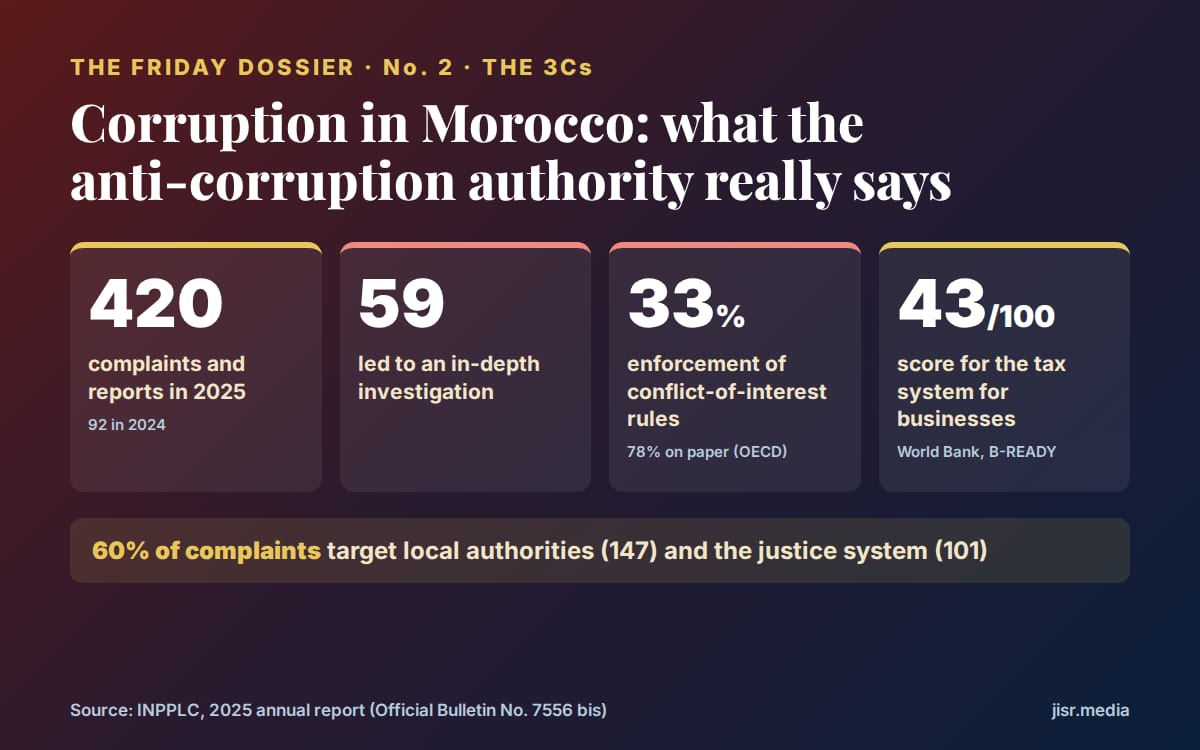
Of 420 complaints received in 2025, only 59 led to a real investigation (p. 250).
76% or 54%?
The 2015-2025 anti-corruption strategy claims 76% completion. Projects actually completed: 54%. And 14% never launched (p. 79).
0%
Lobbying rules actually enforced, according to the OECD (pp. 55-56).
1 in 225
94,765 calls to the anti-corruption hotline since 2018, 420 people caught red-handed (p. 62).
8 → 473
Money-laundering convictions: 8 in ten years (2008-2017), 473 in 2025 alone (p. 64).
131st / 179
Morocco's public sector, the weakest component of the V-Dem political corruption index (p. 36).
48%
The authority itself committed MAD 90.9 million of spending in 2025, out of nearly MAD 190 million of appropriations (pp. 283-284).
All figures come from the authority's public 2025 report (pages cited). Ratios are our own calculations.
The report, signed by the authority’s president Mohamed Benalilou, aims for balance. It calls for setting aside both “the alarmist discourse that denies any progress” and “the reassuring discourse that assumes reforms are enough on their own”. We followed the same rule: what is moving, what is stuck, and what it means for citizens, investors and Moroccans abroad.
420 complaints in a year: who dares to report, and who is targeted?
Files received by the authority rose from 85 in 2023 and 92 in 2024 to 420 in 2025, more than four times as many in a single year (p. 248). Complaints jumped from 37 to 237, reports from 55 to 183.
The main reason: the online platform “Tabligh-Fassad” (report corruption), launched in mid-2024. It received 215 files out of 420 on its own. Only 25 were filed in person. Citizens prefer a screen to a counter.
Who is targeted? First, territorial administration and local authorities (147 files), then the justice system (101). Together, nearly 60% of complaints (p. 249). The report cautions that these figures show which sectors worry citizens, not the precise extent of corruption.
And what becomes of these complaints? This is where it hurts (p. 250).
212
outside the authority's remit
82
inadmissible
54
closed, insufficient evidence
59
in-depth review or investigation
More than one complaint in two knocks on the wrong door. The report sees a gap between what citizens expect of the authority, often seen as a counter for every administrative or judicial grievance, and what the law actually allows it to do. It also points to the weak evidence in many reports. In other words: when you want to report abuse in Morocco, you do not always know where to go, or how to prove it.
They said no: three cases from 2026
Behind the figures are people who took a risk. Here are three cases made public this year, all of them triggered by a call to the hotline. Those involved remain presumed innocent.
Taounate, late summer 2026 · a civil-status paper
A man refuses to pay the 300 dirhams demanded for a municipal document. He calls the hotline. The employee is arrested holding the marked banknotes.
Chichaoua, February 2026 · a mayor
The head of the rural municipality of Nfifa is prosecuted for corruption and abuse of power, after a sting organised by prosecutors following a hotline report.
Marrakech, May 2026 · a police officer
An officer from the Al Mhamid district, suspected of demanding a bribe, is arrested with the money on him.
These cases share one thing: a citizen who said no, then a phone call. Since 2018, the hotline has received 94,765 calls. They led to 420 people caught red-handed, all of them convicted (p. 62). That is one call in 225.
Why so few complaints? The report admits it: even after their sharp rise, complaints remain “limited” given the population and the number of public services. It names three obstacles: people know little about the authority’s role, they fear the consequences of reporting, and they know little about their rights (p. 248). In figures: 420 complaints for some 37 million people, barely one for every 88,000.
In court: fewer cases, but less corruption?
Cases pending before the financial crimes divisions fell from 874 in 2024 to 529 in 2025, a drop of 39.47% (p. 63). Good news? The public prosecutor’s office attributes it to the courts clearing their backlog. The authority urges reading the figure “with great caution”: the drop may also reflect fewer cases referred to the courts, slower detection or harder investigations. It does not prove that corruption is falling.
Other figures complete the picture:
- money laundering: 839 cases in 2025, up from 801 in 2024, and above all 473 convictions in 2025 alone, against 8 in ten years between 2008 and 2017 (p. 64), real progress that the report highlights;
- Court of Audit: between January 2024 and September 2025, its prosecutor decided to prosecute 196 people before the financial courts, and 20 files were referred to the criminal courts (pp. 67-68);
- anti-bribery hotline: since May 2018, 94,765 calls, leading to 420 people caught in the act of bribery and convicted (p. 62). The same number as the 2025 complaints, purely by chance.
These people are presumed innocent until a final judgment is handed down.
Laws on paper, but in practice?
That is the common thread of the report. The authority uses the OECD’s public integrity indicators, which score laws and their enforcement separately (pp. 55-56):
On conflicts of interest, the gap is easy to explain: 100% of government members and 99% of MPs declare their interests, but there is no central database, hardly any follow-up checks, and little is known about judges and senior civil servants. As for the national strategy, the report notes that no progress report has been published since 2022.
76% on paper, 54% in practice. This is the report’s most uncomfortable figure. The official review of the 2015-2025 national strategy claims a completion rate of about 76%. But when the authority counts the projects actually finished, it finds only 54%; 32% are still under way and 14% were never launched, even though the strategy has run its course. Only 38% were delivered on time: nearly two projects in three were delayed or stalled (p. 79). Legislative projects are only 44% complete.
"The success of reform is not measured by the number of laws and institutions, but by its ability to change the behaviour of those involved."
INPPLC, 2025 annual report, p. 15 (our translation)
Investing in Morocco: what do the rankings say?
For anyone thinking of investing in Morocco, or bringing their savings home, the report brings together several international rankings. The conclusion is the same everywhere: good rules, slow enforcement.
- World Bank (B-READY): Morocco scores 63.44 points, above the global average (60.11), and ranks 2nd in Africa and in the Middle East–North Africa region. Its regulatory framework (70.06) and services to businesses (64.55) score well, but operational efficiency (55.71) is below the global average. The weakest point: taxation, 43.42 out of 100, followed by business insolvency (50.24) and market competition (60.04) (pp. 47-48).
- Rule of law (World Justice Project): 0.481 in 2025, 91st out of 142 countries, a slight improvement after years of decline. Morocco remains far from its best level (0.527 and 60th place in 2016), and the gap with the global average has widened over ten years. Two pillars declined: constraints on government powers and regulatory enforcement (pp. 40-44).
- Money laundering (Basel AML Index): progress on laws, but a marked deterioration in financial transparency and compliance with international standards, the factor that weighed most on Morocco’s score (pp. 38-39).
- Transparency International: 39 out of 100, 91st out of 182, still below the global average (42).
- Political corruption (V-Dem): a slight deterioration for Morocco (from 0.664 to 0.671), driven by the executive; the public sector remains the weakest link, 131st out of 179 countries, with no real improvement since 2016 (p. 36).
For a Moroccan abroad who buys land, opens a business or invests back home, these figures are concrete: procedures better written than applied, a tax system seen as the weak link, and local authorities attracting the most complaints.
What does it change for you, in practice?
You pay twice
The civil-status document, the certificate, the hospital appointment are already paid for by your taxes. The "coffee" is a second payment, felt most by the poorest. And municipalities, where these everyday papers are handled, are the first target of complaints (147 files).
You do not know which door to knock on
More than one complaint in two goes to the wrong place (212 out of 420). Those who want to report get lost, give up, and the abuse goes on.
The promised safeguards do not exist yet
14% of the anti-corruption strategy's projects were never launched. There is still no central database of interest declarations, and lobbying is unregulated: nobody knows who weighs on public decisions.
Your investment is less protected
For anyone buying land or opening a business in Morocco, good laws poorly enforced mean longer procedures, a tax system rated hard to read (43 out of 100) and uncertain legal remedies.
Trust wears away
The public sector remains the weakest link (131st out of 179 countries), with no progress since 2016. Every "coffee" paid teaches the young that rules do not matter.
Barring sanctioned officials from elections: who will dare?
The report sets out the opinions sent to Parliament in 2025. Some proposals go far (pp. 102-104):
- barring from legislative elections anyone sanctioned by the financial courts for mismanaging public money (article 54 of the Financial Courts Code);
- moving MPs’ conflict-of-interest rules from the House’s internal rules into an organic law, with mandatory declarations and sanctions;
- requiring parties to adopt ethics charters for selecting candidates, and opening their accounts filed with the Court of Audit to the public;
- protecting whistleblowers who report electoral fraud in good faith.
On criminal procedure, the authority stands by its criticism: articles 3 and 7 of Law 03.23 “go back on gains made in 2003” by limiting the role of civil society and prosecutors when public money is at stake (pp. 106-108). We covered this on Wednesday.
PART 2 · FOLLOWING UP ON DOSSIER No. 1 · OCP/UM6P
Conflicts of interest, the sulphur bill, and our questions to Mostafa Terrab
MAD 30.9bn
of sulphur imported in 9 months (11.2bn a year earlier)
−MAD 2.84bn
OCP net loss, first half of 2026
≈ MAD 38bn
received by UM6P, no accounts published
FOLLOWING UP ON DOSSIER No. 1 · OCP/UM6P
This week, our questions go to Mostafa Terrab: what does he know about what is happening on the floors below?
A week ago, our Friday Dossier No. 1 asked what UM6P does with OCP's money. Since then, our written questions to UM6P and OCP management on research funding and human resources have gone unanswered. Yet the future of several of the group's projects depends on them.
Sulphur, a telling sign. According to Morocco's foreign exchange office, the country's sulphur purchases rose from DH 11.2 billion to DH 30.9 billion at the end of September 2026. Sulphur is essential for turning phosphate into fertiliser. In September 2026, OCP and UM6P set up a centre of excellence on sulphur (SULFEX). According to our sources at OCP, that is late: since UM6P opened, the funds set aside for research have not met their objectives, and the group's dependence on this imported raw material shows it.
Observers point the finger at Mostafa Terrab himself: a lack of long-term vision for research, and close aides who reportedly do not keep him informed of the reality on the ground. Mr Terrab is OCP's chief executive, chairman of the OCP Foundation, which owns UM6P, and a member of the university's board. Our letter of 23 October, which put thirteen questions to him, has gone unanswered.
An industrialist's view
Youssef C., a Casablanca industrialist close to the sector, gave us his analysis. Sulphur, he explains, comes mainly from gas producers and refineries, hence Morocco's dependence on the Gulf states. In his view:
- OCP missed an opportunity with its partnership with Nigeria's Dangote group, which could have given it access to Nigerian gas;
- the Samir refinery, shut since 2015, could on its own have covered about 10% of sulphur needs;
- Morocco should develop local sources (mines, by-products) to master the technology, and build a strategic stock of at least one year;
- OCP's biggest risk is drifting away from its core business: a university, hotels, football…
"Governance and checks and balances can slow decisions down, but they can prevent situations like this one."
Falling results. In the first half of 2026, OCP posted a net loss of DH 2.84 billion (group share), against a profit of DH 8.2 billion a year earlier. Revenue fell 7% to DH 48.4 billion, and EBITDA by 28.5%. Among the causes, the group itself cites the sharp rise in sulphur prices.
The SASE bachelor's programme in Rabat: launched before it was authorised. According to our sources, parents enrolled their children at UM6P's School of Applied Sciences & Engineering (SASE) for a four-year programme presented as engineering training. But, again according to our sources, the programme was launched in a rush, before accreditation was obtained: despite pressure, the Ministry of Higher Education authorised only a three-year licence (bachelor's degree). As a result, students in the first cohort, now in their third year, are being offered a plain UM6P licence; those who stay a fourth year would receive the equivalent of a first year of a master's. A far cry from an engineering degree. For families, the bill is estimated at more than DH 120,000 per student per year, by our calculations: DH 75,000 in tuition listed for 2026-2027, a DH 5,000 registration fee, about DH 2,000 a month for housing, plus food. As of today, the school's website shows only a "coming soon" page.
Our questions to UM6P and OCP management, also unanswered, concern:
- the contracts governing research funding by OCP and its foundation: duration, amounts, expected results, accountability;
- evaluation: who assesses funded projects, with which outside experts, and under what conflict-of-interest rules? Do the chairs deliver results, and to whom?
- the real impact of this research on OCP: what technology transfers in three years?
- sulphur: since when has UM6P been working on it, with what budgets and results, and when could a solution be used at industrial scale?
- the future of funding: how long is OCP committed, and is there a plan to diversify the university's resources?
- the SASE bachelor's programme: who decided to launch a four-year programme without accreditation, what happens to the first cohort, and will families be compensated?
- human resources: whether recruitment and pay criteria are published, how staff numbers and the payroll have changed since 2023, any pay freezes or cuts since 2025, and departures of professors and researchers in 2025 and 2026.
These come on top of the questions we have been asking since September: why does UM6P, which has received some DH 38 billion, publish no accounts (in French)? And why has the Toubkal supercomputer, which fell from 98th to 409th place worldwide, never published any results (in French)?
Our position. After this dossier, we will assume that Mr Terrab is aware of everything. If he takes no decision to reform, constructively, subsidiaries that spend without counting the cost while the group's results decline, that will be his choice, and it will be up to him to explain it.
Our pages remain open to Mr Terrab, OCP, the OCP Foundation and UM6P. Their replies will be published as received.
And our investigations?
The report names no specific case. But its findings match those of our investigations: local authorities, top of the complaints list, are also those that have failed to collect DH 48.5 billion in local taxes (in French); the justice system, second on the list, also receives complaints from Moroccans abroad, 698 to the Superior Council of the Judiciary (in French); conflict-of-interest rules enforced at 33% are the question raised by the ten positions held by Hicham El Habti (in French) within the OCP group and UM6P.
Editor's note · Our only side: the public interest
The OCP story also divides the Moroccan press. On 10 November, the site le360 published a very harsh analysis of Mostafa Terrab's governance in the sulphur crisis; since 2025 the same site has accused another outlet, Le Desk, of being close to the group's communications. In a video posted on social media on 12 November, journalist Taoufik Bouachrine defended Mr Terrab and criticised le360.
These outlets are not strangers to one another: their disputes go back a long way. Hence a question every reader is entitled to ask: is this a debate about OCP, or a settling of scores between media outlets? And if so, who benefits? While the press quarrels over one man, the real questions remain unanswered: the sulphur bill, the governance of the country's largest public group, and the money entrusted to UM6P.
Jisr.media has been investigating OCP and UM6P since September 2026: some fifteen articles in three languages, and letters that have gone unanswered.
Jisr.media takes no part in these quarrels. We are neither for nor against any individual. Our neutrality is a positive one: it leans only one way, towards the community and public money. We ask documented questions, publish the answers in full, and also acknowledge progress.
Jisr.media is not, and never will be, in the pay of any party. Our charter guarantees it: we refuse any donation from a political party, a government, a public body or state-owned company, or anyone concerned by our investigations; donations are capped at US$500 per donor per year; and we will publish an annual report of donations received.
The uncomfortable questions
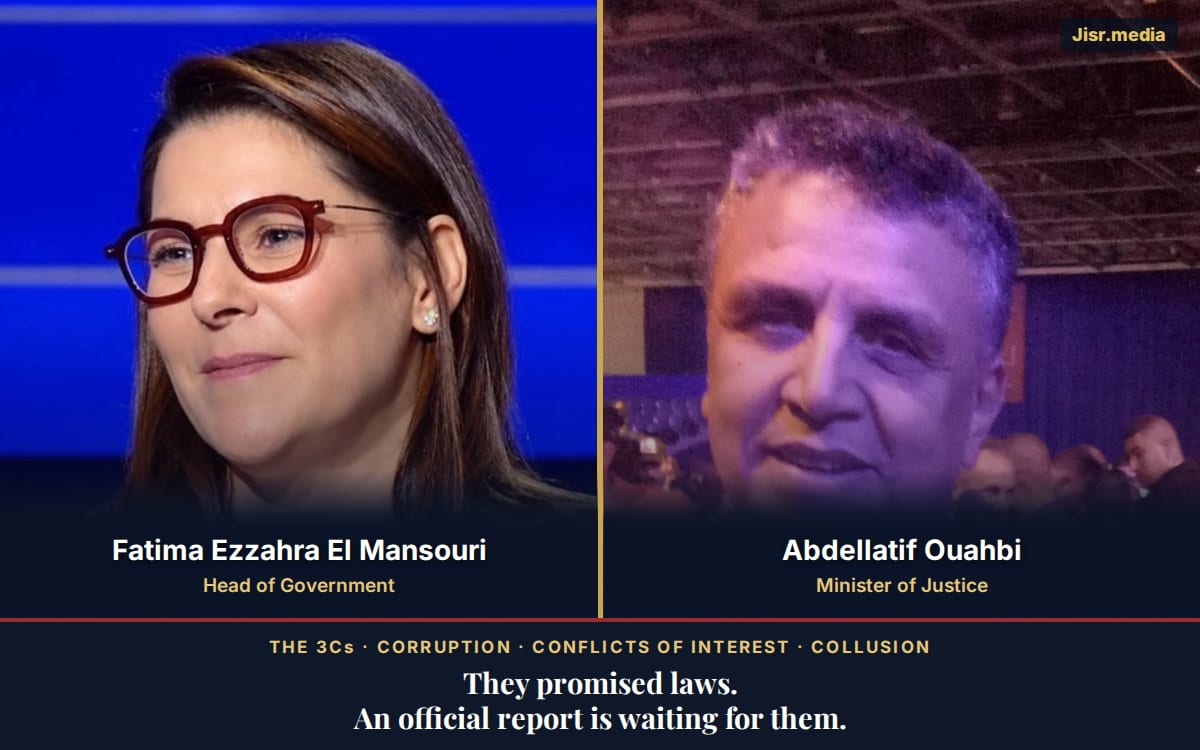
To the Head of Government, Fatima Ezzahra El Mansouri: will you finally publish a progress report on the anti-corruption strategy, the first since 2022? When will a central database of interest declarations be set up? The official review of the strategy claims 76%; the authority counts 54% of projects completed and 14% never launched. Which figure is true, and who will answer for the projects never launched?
To the Minister of Justice, Abdellatif Ouahbi: will the laws promised for 2027 include the proposal to bar from elections officials sanctioned by the Court of Audit? Will you reverse articles 3 and 7 of the criminal procedure law? Why must an association obtain your permission to join proceedings as a civil party in a case involving public money?
To the authority’s president, Mohamed Benalilou: of the 59 files investigated in depth in 2025, how many were referred to the courts? And what happens to the 212 complaints outside your remit: are they passed on to the competent body? Your authority committed MAD 90.9 million out of nearly MAD 190 million in 2025, and the construction of its headquarters has fallen behind: how do you explain this?
Have you witnessed corruption, conflicts of interest or collusion, in Morocco or in a Moroccan project abroad? Write to us in complete confidence: [email protected]. We protect our sources.
See you next Friday for Friday Dossier No. 3.
Also on Jisr.media:
- Morocco’s 3Cs: El Mansouri and Ouahbi make promises, the anti-corruption authority sounds the alarm
- Friday Dossier No. 1 — UM6P: over DH 300,000 a month for some, grades adjusted on request. Who pays?
- OCP/UM6P investigation, part 4: $250 million of venture capital in Delaware, while Morocco runs short of water
FAQ
How many complaints did Morocco’s anti-corruption authority receive in 2025? 420 files, up from 92 in 2024 and 85 in 2023: 237 complaints and 183 reports. More than half (215) came through the online platform launched in mid-2024; only 25 were filed in person.
What happened to those complaints? Of the 420 files reviewed in 2025, 212 fell outside the authority’s remit, 82 were declared inadmissible, 54 were closed for lack of evidence and 59 moved on to in-depth review or investigation.
What does the report tell investors? According to the World Bank’s B-READY report, as analysed by the authority, Morocco scores 63.44 against a global average of 60.11. Its regulatory framework (70.06) and public services for firms (64.55) are above average, but operational efficiency (55.71) is below it, and the tax system (43.42) is the weakest point.
Who heads Morocco’s anti-corruption authority? Mohamed Benalilou, who signs the foreword of the 2025 annual report, published in Official Bulletin No. 7556 bis on 30 October 2026.
Sources
- INPPLC, 2025 annual report, Official Bulletin No. 7556 bis, 30 October 2026. Pages cited from the printed report: 15 (key messages), 38-48 (Basel, World Justice Project, World Bank), 55-56 (OECD), 62-68 (judicial data and Court of Audit), 102-108 (opinions to Parliament and criminal procedure), 248-250 (complaints and reports).
- OCP, consolidated first-half 2026 results, published 29 September 2026; revenue confirmed by the quarterly indicator filed with Morocco’s capital markets authority (AMMC).
- International indicators (OECD, World Bank B-READY, World Justice Project, Basel Institute on Governance, Transparency International) as presented in the report.