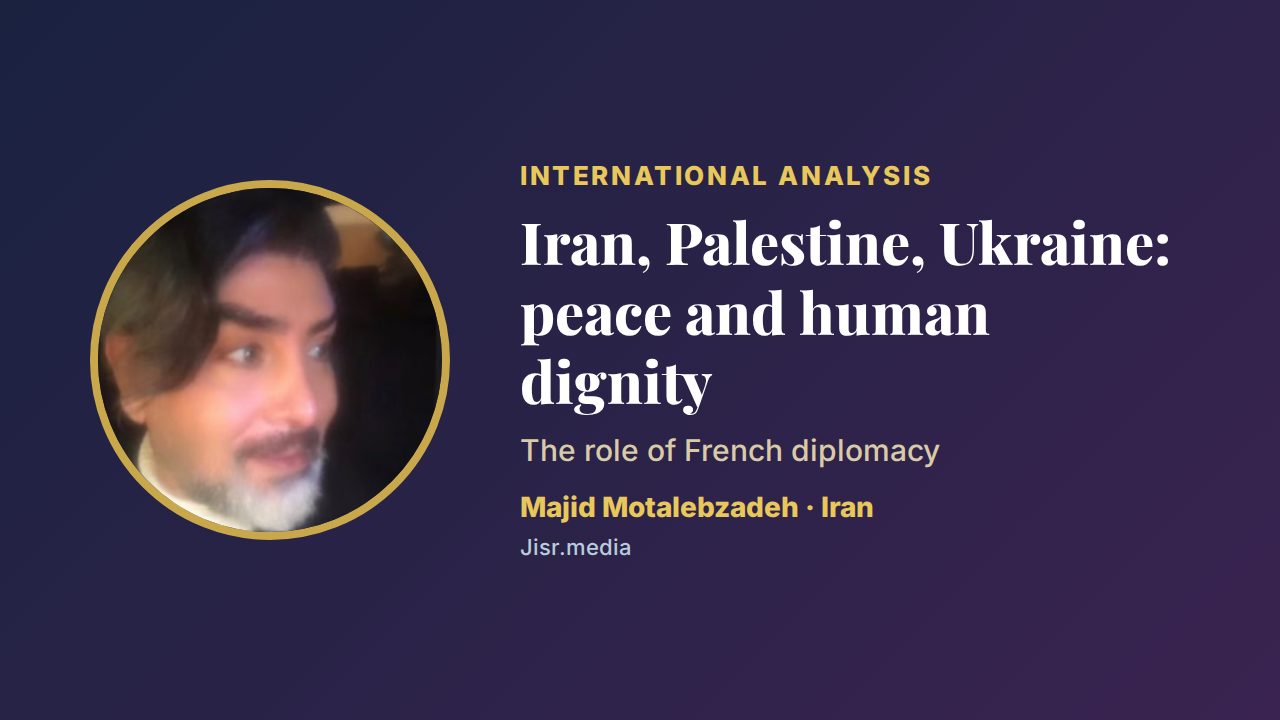
🤝 Welcome to a new voice, from Iran
Jisr.media welcomes Iranian investigative journalist Majid Motalebzadeh to its International analysis section with his first contribution: a plea for peoples, above governments. Originally written in French; translated by the Jisr.media newsroom.
Imprisoned in 2020 for his opinions, Majid joins the ranks of journalists, in Morocco and elsewhere, who have been or are still deprived of their rights and their freedom of expression. That deprivation has pushed many journalists to leave their country. Not Majid: despite the war, he keeps fighting with his pen, from the inside.
By Majid Motalebzadeh
Human dignity above political conflicts
In a world marked by wars, international tensions and humanitarian crises, one essential question should remain at the heart of every political decision: what value do we place on human life?
The death of civilians, wherever it occurs, is a tragedy. The killing of children and civilians in Ukraine, Palestine and Iran has no moral justification. No political, military or strategic consideration can make the death of innocent people acceptable.
The Ukrainian, Palestinian and Iranian peoples, like all the peoples of the world, aspire to live in safety, without bombs or missiles. Palestinians, too, grieve the deaths of Ukrainian, Iranian or other children. The suffering of families knows neither borders nor nationalities.
I cannot see images of people killed in Ukraine and Palestine without feeling deep pain. Behind every victim there is a family, interrupted dreams, and a life that can never resume its course.
Policies of confrontation and forced migration
Many people leave their country not by choice, but to protect their lives and those of their loved ones. Bombings, missiles, insecurity and the destruction of homes force entire families to abandon their houses, and sometimes their country.
The European Union, with its experience and its diplomatic and humanitarian capabilities, can help strengthen international dialogue and the search for solutions that reduce tensions.
Migration should not be seen only through the lens of borders. Behind every person forced to leave there is a human story, a family that has lost its security and sometimes everything it owned.
It is therefore important to support displaced people, while continuing the efforts needed to address the root causes of conflict and insecurity.
The Iranian people should not pay the price of political conflicts
For many years, Iranians have sometimes been portrayed in certain political discourse as a threat or associated with accusations of terrorism. Yet ordinary Iranian citizens also suffer the consequences of violence, international sanctions and economic restrictions, particularly those imposed by the United States.
Banking isolation, difficulties with financial transfers and obstacles to certain international transactions have concrete consequences on daily life. Difficult access to medicine and essential goods is a particular concern for the most vulnerable families.
It is essential to distinguish peoples from governments. Citizens should never be held collectively responsible for the political decisions of their leaders.
Citizens should never be held collectively responsible for the political decisions of their leaders.
One can profoundly disagree with a government without accepting that its population should bear the consequences of that disagreement.
My journalistic independence: defending peoples, not governments
I want to make clear that my approach is not to defend a government or a political movement. I am not seeking to justify the decisions of the Iranian government, to praise any political power, or to defend Hamas.
My commitment rests on one principle: the defence of human dignity and civilian lives.
One cannot claim to seek peace while accepting the death of innocent people.
Political differences and international rivalries must never turn into a war waged against populations. One cannot claim to seek peace while accepting the death of innocent people.
A journalist’s role is also to ask questions, to give a voice to those whose suffering sometimes remains invisible, and to remind us that human life must remain above political interests.
More than seventy years of conflict: why is peace so hard?
The Israeli-Palestinian conflict has lasted for more than seven decades. Despite many diplomatic initiatives and attempts at negotiation, a lasting peace remains out of reach.
It is legitimate to ask which political, strategic and economic interests make a just and lasting solution so difficult to achieve.
Peace cannot be built without taking into account the rights, security and dignity of Palestinians. It also requires an approach that protects civilian populations and allows future generations to live without fear.
The expansion of the Abraham Accords and new regional cooperation initiatives may open diplomatic prospects. However, lasting stability in the Middle East cannot be envisaged without a serious and fair answer to the Palestinian question.
France: a voice for peace and human dignity
France holds a special place in the modern history of freedoms, human rights and international diplomacy. The values of liberty, equality and fraternity, rooted in the French republican tradition, continue to carry universal weight.
Through its diplomatic role, its permanent seat on the United Nations Security Council and its cultural influence, France has a significant capacity to foster dialogue between peoples.
In the crises in Palestine and Ukraine, French diplomacy can help reduce tensions, protect civilians and seek political solutions that allow a just and lasting peace.
France also has a remarkable international cultural dimension. The French language brings together hundreds of millions of people around the world and is a precious link between different societies, cultures and sensibilities.
This international presence is a real opportunity to encourage dialogue, intellectual cooperation and exchanges between journalists, writers and citizens.
In my view, France’s strength lies not only in its political or diplomatic influence. It also lies in its ability to defend universal human values and to make room for freedom of expression, pluralism and human dignity.
Diplomacy and the responsibility of the international community
International organisations and human rights institutions have an essential role to play. However, statements and resolutions should not remain mere texts without concrete consequences for the populations who suffer.
International meetings, condemnations and calls for peace must be accompanied by real efforts to protect civilians, facilitate humanitarian aid and prevent further violence.
Peoples expect more than declarations of solidarity. They need results that make a difference in their daily lives and can prevent new tragedies.
The international community must make the protection of human life a concrete priority, not merely a principle written into speeches.
My faith, my convictions and my responsibility as a journalist
I am of the Zoroastrian faith. The principles of my spiritual tradition rest in particular on three fundamental values: good thoughts, good words and good deeds.
These values have deeply shaped the way I look at the world and understand human responsibility.
I myself am going through difficult times and personally facing pressure. Yet I do not want to lay down my pen in the face of injustice, wherever it occurs: in Palestine, in Ukraine or in Iran.
I do not claim to be immune to suffering. I know what it means to live under pressure and uncertainty. But I believe personal hardship should not lead us to close our eyes to the pain of others.
As a journalist, I want to keep writing, not to defend governments or the powerful, but to defend truth, freedom and human dignity.
As long as I am able to write, I will not give up making heard the voices of those whose suffering is too often forgotten.
A future without bombs or missiles
The peoples of Ukraine, Palestine, Iran and elsewhere dream above all of a peaceful life. They want their children to go to school without fear, families to stay together, and no mother to be woken in the middle of the night by an explosion, afraid she will never see her child again.
Behind every war there are not only figures, destroyed buildings and redrawn borders. There are broken lives, interrupted dreams, vanished homes and families who may never be reunited.
I dream of a world in which Ukrainian, Palestinian, Iranian children, and those of every other nation, can grow up without knowing the fear of war.
Peace is not just the signing of an agreement between leaders. It begins when a child can sleep peacefully, when a family no longer fears losing its home, and when a human being can live with dignity in their own country.
I hope that one day, instead of weapons and missiles, we will see messengers of peace crossing borders to bring peoples closer together.
For in the end, it is neither borders nor balances of power that give meaning to our existence. It is our capacity to recognise the suffering of others and never to remain indifferent to human pain.
Peace belongs to no government, no religion and no nation. It is a right for all human beings.
Peace belongs to no government, no religion and no nation. It is a right for all human beings.
Majid Motalebzadeh
Iranian journalist, investigative journalist
Write for Jisr.media
Researchers, writers and journalists from Morocco, Algeria, Iran, the Gulf and beyond: our pages are open to your analysis and opinions, in English, French or Arabic, with a right of reply.
FAQ
What does Majid Motalebzadeh defend in this text?
Human dignity and civilian lives above political rivalries, without defending any government.
Why does he write about sanctions on Iran?
Because they fall first on ordinary citizens: banking isolation, difficult transfers, medicine harder to obtain.
What role does he see for France?
A voice for dialogue and the protection of civilians, through its Security Council seat and the French-speaking world.
Who is Majid Motalebzadeh?
An Iranian investigative journalist and a new contributor to Jisr.media.
Also on Jisr.media: