First published in French and Arabic by Jisr.media on 11 November 2026; translated by the Jisr.media newsroom.
In brief. Corruption, conflicts of interest, collusion: the 3Cs. Morocco's Head of Government and her Justice Minister promise laws against corruption and conflicts of interest. At the same time, the institution in charge of fighting corruption writes that the minister's criminal procedure reform has reduced the means to prosecute it. On Friday 13 November, our Friday Dossier No. 2 (in French and Arabic) will take apart this 298-page report and what it says about our own investigations.
Context for international readers
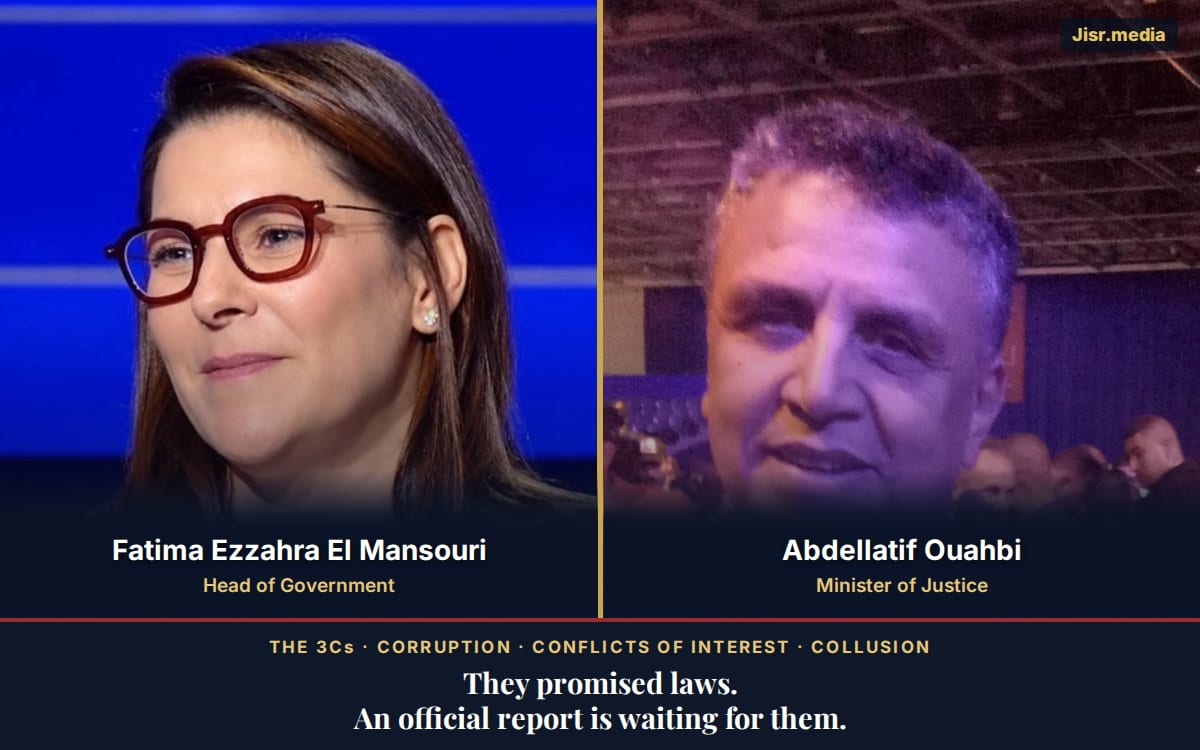
Fatima Ezzahra El Mansouri heads the government formed after Morocco's legislative elections of 23 September 2026; she won a confidence vote on 22 October. Abdellatif Ouahbi has been Minister of Justice since 2021. The INPPLC is the national anti-corruption authority provided for by the 2011 Constitution.
Why it matters for investors and Moroccans abroad: the weak enforcement of conflict-of-interest rules, the absence of any framework for lobbying and the corruption risks in public procurement and urban planning that the report points to are exactly what a foreign investor, or a Moroccan living abroad who invests back home, runs into when dealing with the administration.
On Monday 2 November, in Morocco’s House of Representatives, five parliamentary groups questioned the Justice Minister about corruption. Abdellatif Ouahbi replied with a promise: three bills, on illicit enrichment, conflicts of interest and money laundering, for early 2027. Perhaps even a separate anti-corruption code, taken out of the Criminal Code. One condition, he insisted: respect for the presumption of innocence.
He is not alone in making commitments. On 19 October, presenting her 2026-2031 programme, Head of Government Fatima Ezzahra El Mansouri promised to punish illicit enrichment and conflicts of interest, and to strengthen asset declarations. Without giving any date (in French). Three days later, during the confidence vote (in French), she reaffirmed her support for making illicit enrichment a crime.
A promise with a sense of déjà vu. In 2021, the Akhannouch government, in which Abdellatif Ouahbi was already Minister of Justice, withdrew from Parliament the Criminal Code reform that contained precisely the offence of illicit enrichment.
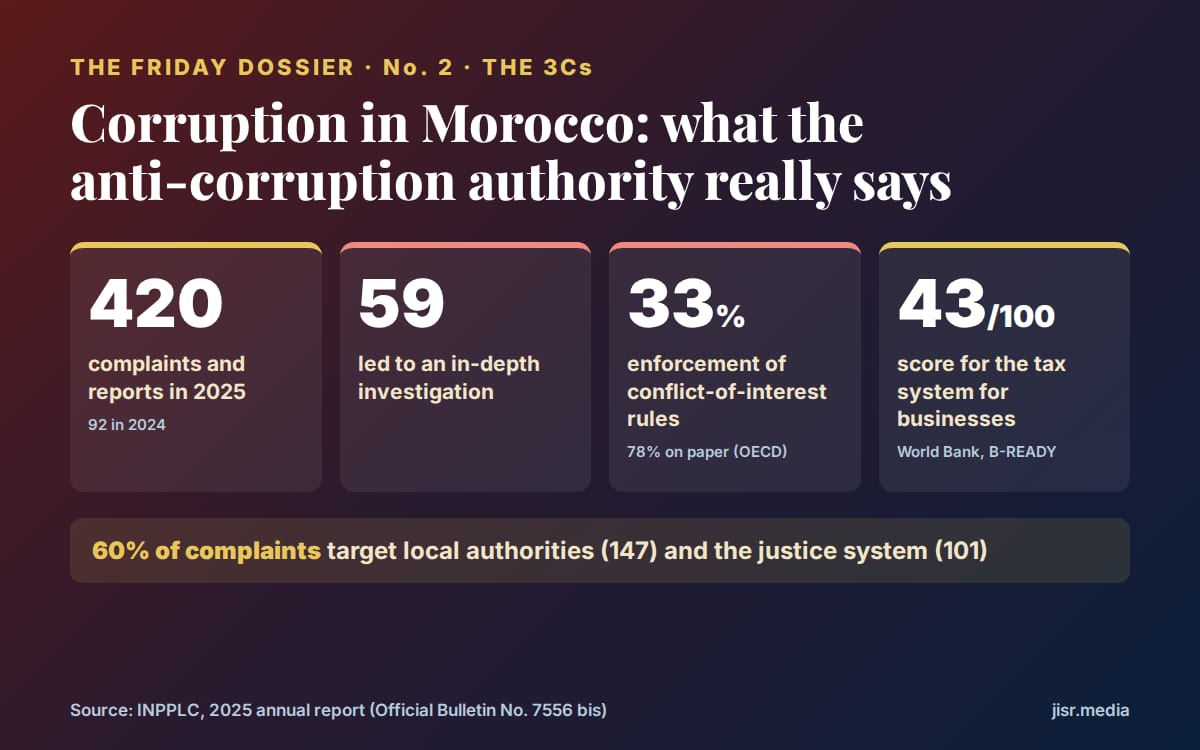
Three days before that sitting, Official Bulletin No. 7556 bis (30 October 2026) published the 2025 annual report of the National Authority for Probity, Prevention and the Fight against Corruption (INPPLC). We have read it. It casts a harsh light on the minister’s promise.
Ten years of strategy: one promise in two kept?
Morocco’s national anti-corruption strategy, launched in 2015, ended in 2025. The official completion rate: about 76%. The authority rejects that figure, which counts projects still under way as “completed”.
With stricter indicators, the picture changes:
54%
of projects actually completed
14%
never launched
38%
completed on time
44%
of planned bills passed
It is precisely the laws that stalled the most. Illicit enrichment, conflicts of interest, an overhaul of asset declarations, whistleblower protection: the authority lists them among the “postponed structural reforms”. Exactly the texts the minister is promising today.
“A step back since 2003”: the sentence aimed at Ouahbi
This is the strongest passage in the report. On the criminal procedure reform (Law 03.23), steered by the Minister of Justice, the authority writes (our translation) that several amendments:
“went back on gains that had existed since 2003, through articles 3 and 7, which restrict the role of civil society in reporting and that of the public prosecutor in prosecuting when public funds are at stake, in clear contradiction with constitutional principles and Morocco’s international commitments.”
In practice, the authority is concerned about three things:
- prosecutors held back: investigations into the misuse of public funds depend on a request from the Prosecutor General at the Court of Cassation, based on reports by administrative bodies “sometimes attached to ministries that may themselves be involved”;
- associations under supervision: to join proceedings as a civil party, a public-interest association must first obtain the authorisation… of the Minister of Justice;
- the statute of limitations: it runs from the date of the facts, whereas corruption is often uncovered years later.
In other words: new offences are being promised, but the doors through which they reach a judge have been narrowed.
Conflicts of interest: 78% on paper, 33% in practice. Who checks?
Is Morocco making progress? A little, according to the indicators. In Transparency International’s index published in February 2026, Morocco climbs to 39/100 (91st out of 182), up from 37 and 99th place a year earlier. It is the first rise since 2018. But the country remains below the global average (42), and far from its best score: 43 in 2018.
Other figures in the report temper the improvement:
- according to the OECD, Morocco scores 78% for its legal framework on conflicts of interest, but 33% for enforcement; for the regulation of lobbying, 0%;
- cases pending before the financial crimes divisions fell from 874 in 2024 to 529 in 2025 (−39%), a drop the report says should be read “with great caution”;
- since 2018, the corruption-reporting hotline has received 94,765 calls, leading to 420 arrests of people caught in the act of bribery;
- between January 2024 and September 2025, Morocco’s Court of Audit referred 20 cases to the criminal courts, mainly involving public procurement, public property and urban planning, the areas where the report locates the risks of “collusion” and influence peddling. These cases are in the hands of the judges: the people concerned are presumed innocent.
And our investigations?
This report deals with subjects we have been following for months. The absence of a conflict-of-interest law came up in our coverage of the desalination project and of the overlapping positions at the head of OCP, the state phosphate group, and the Mohammed VI Polytechnic University (UM6P). The oversight of public money, in our investigations into UM6P and Royal Air Maroc, and in the Court of Audit’s findings on state-owned enterprises. The statute of limitations and money never recovered, in the CNSS (social security fund) case. We will come back to this in detail on Friday.
El Mansouri, Ouahbi: our questions. When will they answer?
To the Head of Government:
- Your programme promises to punish illicit enrichment and conflicts of interest: on what date will the bills be tabled in Parliament?
- Will you publish a timetable and a progress report for the new anti-corruption strategy, as the authority recommends?
To the Minister of Justice:
- Will you reverse articles 3 and 7 of the criminal procedure law, as the anti-corruption authority asks?
- Will the bills promised for 2027 follow the authority’s recommendations, in particular on the statute of limitations and the verification of asset declarations?
- Why were the texts withdrawn in 2021 not put back on the table sooner?
And you? Have you witnessed corruption, conflicts of interest or the misuse of public money, in Morocco or in a Moroccan project abroad? Write to us in complete confidence: [email protected]. We protect our sources.
Also on Jisr.media:
- UM6P: over DH 300,000 a month for some, grades adjusted on request. Who pays?
- OCP/UM6P investigation, part 4: $250 million of venture capital in Delaware, while Morocco runs short of water
- El Mansouri’s programme: promises, but for when? (in French)
- OCP/UM6P investigation: 38 billion, no published accounts. Who controls UM6P’s money? (in French)
- State-owned enterprises: four years on, the Court of Audit finds the reform is stalling (in French)
- Royal Air Maroc investigation: six years of public money, and who is accountable? (in French)
FAQ
What has Fatima Ezzahra El Mansouri promised against corruption? In her 2026-2031 government programme, presented on 19 October 2026, Morocco’s Head of Government promises to punish illicit enrichment and conflicts of interest and to strengthen asset declarations, without setting a date for tabling the laws.
What did Abdellatif Ouahbi promise on 2 November 2026? Before the House of Representatives, the Justice Minister announced three bills for early 2027, on illicit enrichment, conflicts of interest and money laundering, possibly combined into a stand-alone anti-corruption code, provided the presumption of innocence is respected.
What is the INPPLC’s 2025 annual report? It is the report of Morocco’s National Authority for Probity, Prevention and the Fight against Corruption (INPPLC), a constitutional body, published in Official Bulletin No. 7556 bis on 30 October 2026. It assesses corruption in Morocco and the 2015-2025 national strategy.
Why does the authority criticise the criminal procedure reform? According to the report, articles 3 and 7 of the reform restrict reporting by civil society and action by prosecutors in cases involving public funds, a step back from gains made in 2003 that contradicts the Constitution and Morocco’s international commitments.
Is Morocco making progress against corruption? A little: 39/100 and 91st place in Transparency International’s 2025 index, up from 37 and 99th in 2024. But the score remains below the global average (42) and below its 2018 level (43).
Sources
- INPPLC, 2025 annual report (Official Bulletin No. 7556 bis, 30 October 2026), in particular pp. 28-32 (indicators), 62-70 (judicial data), 79-82 (assessment of the strategy) and 105-108 (criminal procedure), report pagination.
- House of Representatives, oral questions session of 2 November 2026.
- Government programme 2026-2031, presented on 19 October 2026, and the confidence vote debate of 22 October 2026.