THE FRIDAY DOSSIER NO. 2 · PART 2
This part first appeared on 13 November in our Friday Dossier No. 2 on everyday corruption (part 1). We now publish it as a stand-alone article, so it can be read and shared on its own. It follows our Friday Dossier No. 1 on UM6P.
PART 2 · FOLLOWING UP ON DOSSIER No. 1 · OCP/UM6P
Conflicts of interest, the sulphur bill, and our questions to Mostafa Terrab
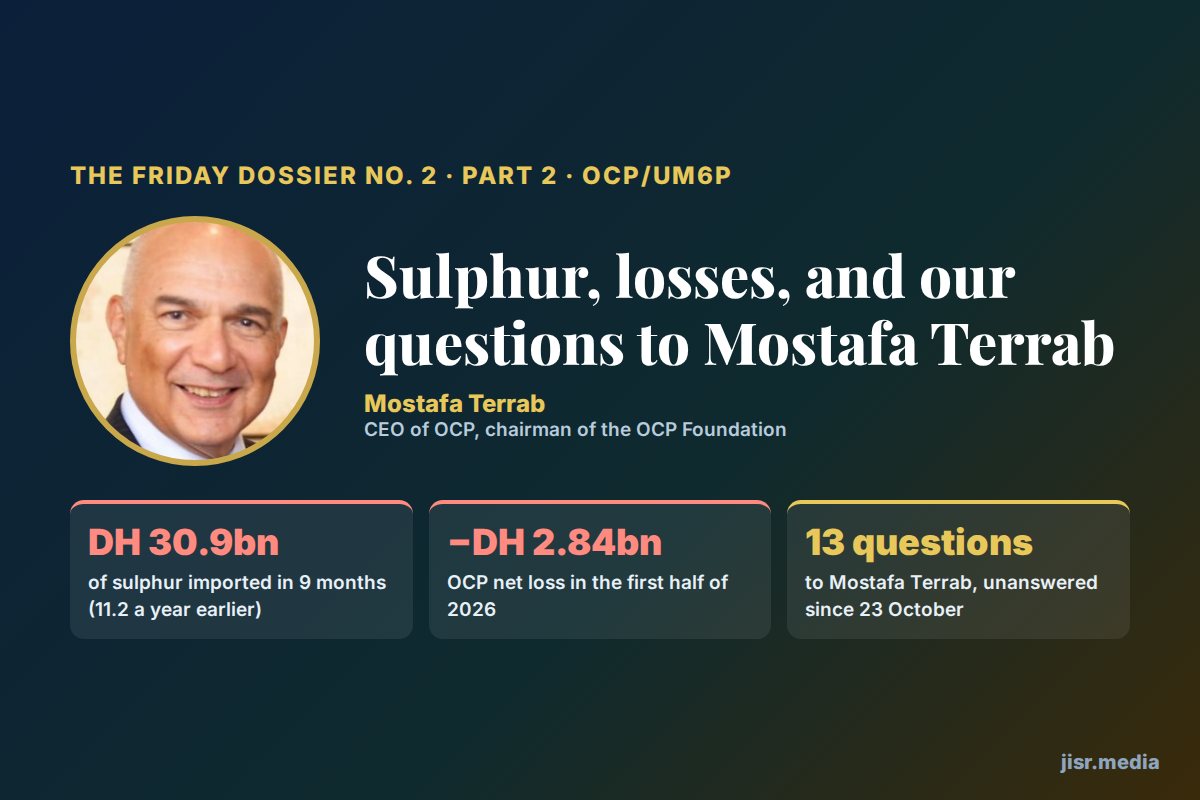
MAD 30.9bn
of sulphur imported in 9 months (11.2bn a year earlier)
−MAD 2.84bn
OCP net loss, first half of 2026
≈ MAD 38bn
received by UM6P, no accounts published
FOLLOWING UP ON DOSSIER No. 1 · OCP/UM6P
This week, our questions go to Mostafa Terrab: what does he know about what is happening on the floors below?
A week ago, our Friday Dossier No. 1 asked what UM6P does with OCP's money. Since then, our written questions to UM6P and OCP management on research funding and human resources have gone unanswered. Yet the future of several of the group's projects depends on them.
Sulphur, a telling sign. According to Morocco's foreign exchange office, the country's sulphur purchases rose from DH 11.2 billion to DH 30.9 billion at the end of September 2026. Sulphur is essential for turning phosphate into fertiliser. In September 2026, OCP and UM6P set up a centre of excellence on sulphur (SULFEX). According to our sources at OCP, that is late: since UM6P opened, the funds set aside for research have not met their objectives, and the group's dependence on this imported raw material shows it.
Observers point the finger at Mostafa Terrab himself: a lack of long-term vision for research, and close aides who reportedly do not keep him informed of the reality on the ground. Mr Terrab is OCP's chief executive, chairman of the OCP Foundation, which owns UM6P, and a member of the university's board. Our letter of 23 October, which put thirteen questions to him, has gone unanswered.
An industrialist's view
Youssef C., a Casablanca industrialist close to the sector, gave us his analysis. Sulphur, he explains, comes mainly from gas producers and refineries, hence Morocco's dependence on the Gulf states. In his view:
- OCP missed an opportunity with its partnership with Nigeria's Dangote group, which could have given it access to Nigerian gas;
- the Samir refinery, shut since 2015, could on its own have covered about 10% of sulphur needs;
- Morocco should develop local sources (mines, by-products) to master the technology, and build a strategic stock of at least one year;
- OCP's biggest risk is drifting away from its core business: a university, hotels, football…
"Governance and checks and balances can slow decisions down, but they can prevent situations like this one."
Falling results. In the first half of 2026, OCP posted a net loss of DH 2.84 billion (group share), against a profit of DH 8.2 billion a year earlier. Revenue fell 7% to DH 48.4 billion, and EBITDA by 28.5%. Among the causes, the group itself cites the sharp rise in sulphur prices.
The SASE bachelor's programme in Rabat: launched before it was authorised. According to our sources, parents enrolled their children at UM6P's School of Applied Sciences & Engineering (SASE) for a four-year programme presented as engineering training. But, again according to our sources, the programme was launched in a rush, before accreditation was obtained: despite pressure, the Ministry of Higher Education authorised only a three-year licence (bachelor's degree). As a result, students in the first cohort, now in their third year, are being offered a plain UM6P licence; those who stay a fourth year would receive the equivalent of a first year of a master's. A far cry from an engineering degree. For families, the bill is estimated at more than DH 120,000 per student per year, by our calculations: DH 75,000 in tuition listed for 2026-2027, a DH 5,000 registration fee, about DH 2,000 a month for housing, plus food. As of today, the school's website shows only a "coming soon" page.
Our questions to UM6P and OCP management, also unanswered, concern:
- the contracts governing research funding by OCP and its foundation: duration, amounts, expected results, accountability;
- evaluation: who assesses funded projects, with which outside experts, and under what conflict-of-interest rules? Do the chairs deliver results, and to whom?
- the real impact of this research on OCP: what technology transfers in three years?
- sulphur: since when has UM6P been working on it, with what budgets and results, and when could a solution be used at industrial scale?
- the future of funding: how long is OCP committed, and is there a plan to diversify the university's resources?
- the SASE bachelor's programme: who decided to launch a four-year programme without accreditation, what happens to the first cohort, and will families be compensated?
- human resources: whether recruitment and pay criteria are published, how staff numbers and the payroll have changed since 2023, any pay freezes or cuts since 2025, and departures of professors and researchers in 2025 and 2026.
Update, 14 November 2026 · One more question to Mostafa Terrab
What is the strategic impact of the uranium sector in the coming years?
Moroccan phosphates contain uranium, which can be recovered during the production of phosphoric acid. With the revival of nuclear power, notably in France, this metal is becoming strategic for several industries. Does OCP have a strategy for this sector, with which partners, on what timetable, and how much of the value will stay in Morocco?
These come on top of the questions we have been asking since September: why does UM6P, which has received some DH 38 billion, publish no accounts (in French)? And why has the Toubkal supercomputer, which fell from 98th to 409th place worldwide, never published any results (in French)?
Our position. After this dossier, we will assume that Mr Terrab is aware of everything. If he takes no decision to reform, constructively, subsidiaries that spend without counting the cost while the group's results decline, that will be his choice, and it will be up to him to explain it.
Our pages remain open to Mr Terrab, OCP, the OCP Foundation and UM6P. Their replies will be published as received.
Call for testimonies
Do you work, or have you worked, at OCP, UM6P or one of their subsidiaries? Are you the parent of a SASE student? Write to us. Anonymity is guaranteed and we protect our sources.
Right of reply. Our pages remain open to Mr Terrab, OCP, the OCP Foundation and UM6P.
Also on Jisr.media:
- Friday Dossier No. 2, part 1: 300 dirhams for a civil-status document… You report corruption, and then what?
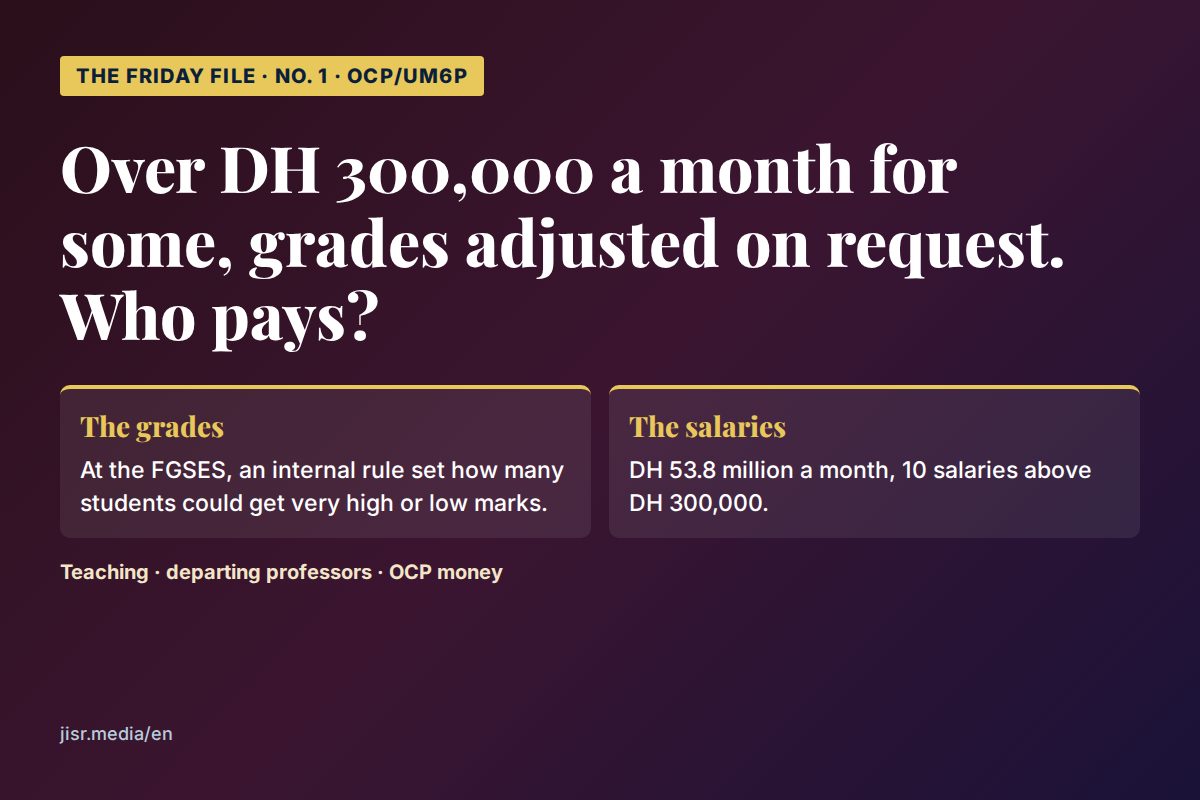
- Friday Dossier No. 1: UM6P, over DH 300,000 a month for some, grades adjusted on request
- OCP/UM6P investigation, part 4: $250 million of venture capital in Delaware
FAQ
Why is sulphur so important for OCP?
Sulphur is used to make the sulphuric acid that turns phosphate into fertiliser. According to the Office des changes, Morocco’s sulphur purchases rose from DH 11.2 billion to DH 30.9 billion by the end of September 2026.
What were OCP’s results in the first half of 2026?
A net loss of DH 2.84 billion (group share), against a DH 8.2 billion profit a year earlier. Revenue fell 7% to DH 48.4 billion. The group itself cites the rise in sulphur prices among the causes.
Why ask OCP about uranium?
Moroccan phosphates contain uranium, which can be recovered during the production of phosphoric acid. With the revival of nuclear power, notably in France, this sector is becoming strategic. We are asking Mostafa Terrab what strategy OCP intends to follow, with which partners and on what timetable.
Has Mostafa Terrab replied to Jisr.media?
No. Our letter of 23 October, with thirteen questions, remains unanswered, as do our questions to UM6P and OCP management. Our pages remain open and their replies will be published as received.
Sources
- Office des changes, foreign trade, end of September 2026 (sulphur purchases).
- OCP, consolidated first-half 2026 results, published 29 September 2026.
- Letter from Jisr.media to Mostafa Terrab, 23 October 2026 (unanswered).