THE FRIDAY FILE · NO. 1
Each week, one in-depth subject, several articles, one question. This week: what UM6P does with OCP's money, from the classroom to the payslip. First published in French on 6 November 2026.
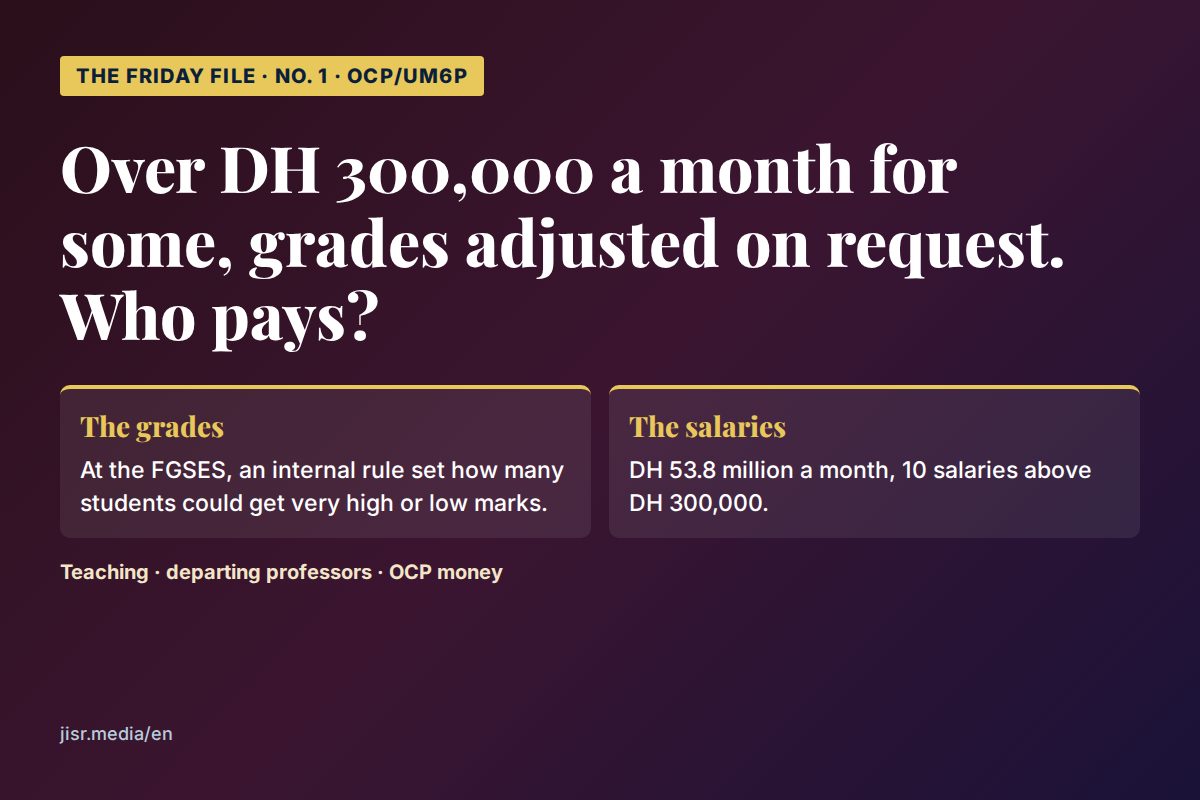
What is a grade worth, and what is a salary worth, when a state-owned company is paying? Two investigations published this Friday ask the same question from two ends. One starts in the classroom: grades revised to fit a quota. The other starts with the payslip: a payroll of more than 50 million dirhams a month, with exceptional salaries at the top.
Context. Mohammed VI Polytechnic University (UM6P), in Benguerir, was created and is largely owned by the OCP Foundation. OCP is Morocco's phosphate and fertiliser group, in which the state holds 94.12% of the capital. DH 10 is roughly US$1.
Teaching, and those who leave
A university is judged first by what happens in the classroom. At the FGSES (Faculty of Governance, Economic and Social Sciences), a rule imported from English-speaking universities set in advance how many students could receive very high or low marks, including in groups of fewer than 20 or 30 students, where such a rule makes little sense. Teachers had to revise their grades at the last minute.
The rule sets no maximum grade: a student can still get 17 or 18 out of 20. It limits the number of very high marks, to no more than 2 students out of 10 above about 16/20.
At the same time, according to testimonies received by Jisr.media since September, competent professors have left the university, and large pay gaps separate staff recruited from abroad and Moroccan teachers (in French). This raises a simple question: is the money going where teaching quality is made?
A payroll funded by public money
UM6P is largely owned by the OCP Foundation, and OCP is a state-owned company in which the state is the majority shareholder. The university’s payroll, between 650 and 920 million dirhams a year depending on the period, is therefore mostly paid with public money. The reasoning is simple: every dirham spent on salaries and benefits is a dirham less in OCP’s profits, and therefore in the dividends that go back to the state. Yet no detailed accounts of UM6P are published (in French), and OCP’s net income fell by 13% in 2025.
And what if, tomorrow, OCP and its Foundation turned off the tap?
Our questions to the university’s leaders
These questions are addressed first to Hicham El Habti, president of UM6P (and secretary general of the OCP group), and to Karim El Aynaoui, executive vice-president of UM6P and dean of the FGSES. They had already been sent in writing to OCP’s chief executive, UM6P’s presidency and other officials. No one has answered these questions. On the grades, however, the FGSES wrote to us on 5 November to dispute our reporting: its reply is published in full (in French).
1. Why such salaries? Why such high pay, with its benefits, especially for professors recruited from abroad?
2. For what results? What do these professors produce, and how are their results measured: research, teaching, graduate employment?
3. What about Moroccan professors? Are national teachers, sometimes paid up to ten times less according to our sources, not good enough?
4. Guaranteed for how long? Is this payroll guaranteed by OCP, and for how long? What are the other sources of funding?
5. On its own funds? If UM6P had to rely on its own resources (tuition fees, research contracts, partnerships), what salaries could it afford?
6. And if the tap is turned off? If OCP or its Foundation reduced its funding, what plans have the current leaders prepared?
Our pages remain open: any reply will be published as received.
STUDENTS, PROFESSORS, UM6P ALUMNI: WRITE TO US
Grades, salaries, departures, working conditions: your testimony helps us verify. Anonymity guaranteed, sources protected.
Also on Jisr.media:
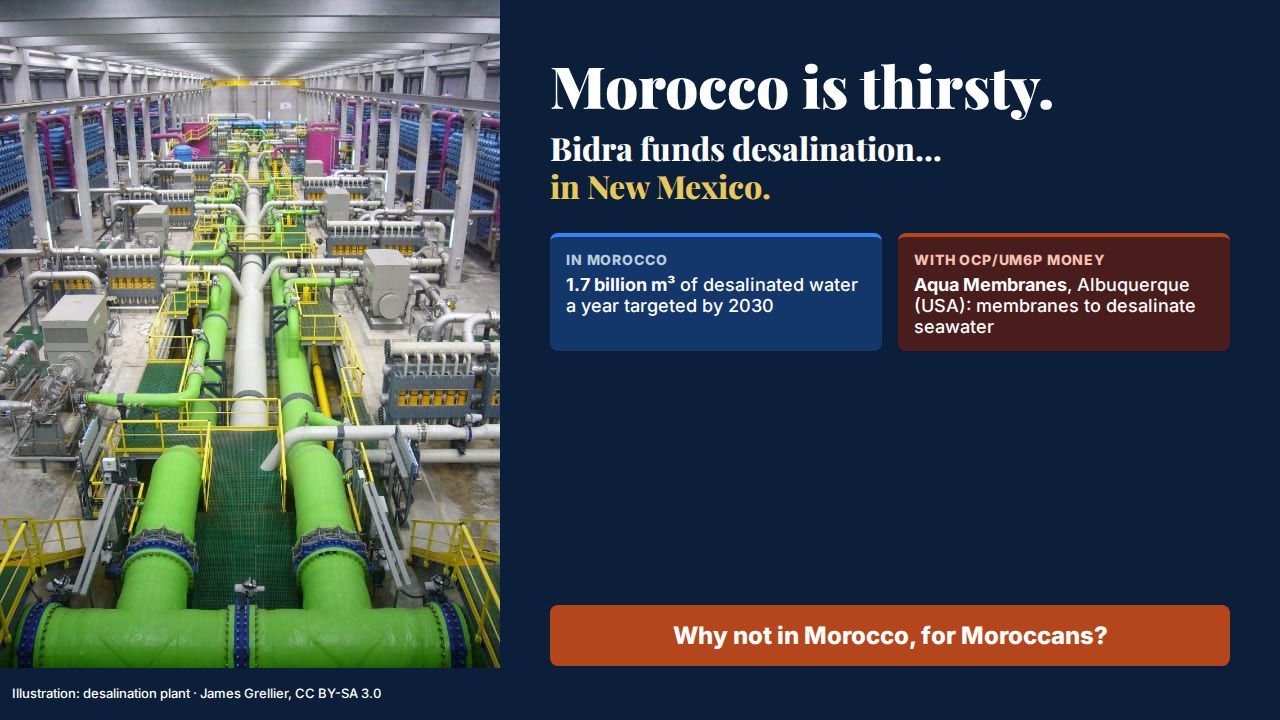
- OCP/UM6P investigation, part 4: $250 million of venture capital in Delaware, while Morocco runs short of water
- Part 8: 38 billion dirhams, no published accounts. Who controls UM6P’s money? (in French)
- Hicham El Habti: ten positions at OCP and UM6P (in French)
- The full OCP/UM6P series (in French)
FAQ
What is UM6P?
Mohammed VI Polytechnic University, in Benguerir, Morocco: a private university created and largely owned by the OCP Foundation, the foundation of Morocco’s state-controlled phosphate group.
What is the Friday File on UM6P?
Two Jisr.media investigations published on 6 November 2026: grades revised at the FGSES, and a payroll of over 50 million dirhams a month.
Where does the money for UM6P’s salaries come from?
Mostly from the OCP group and its Foundation. UM6P publishes no detailed accounts showing the share of each source.
Who are Jisr.media’s questions addressed to?
Hicham El Habti, president of UM6P, and Karim El Aynaoui, executive vice-president and dean of the FGSES. No reply so far.