Abdesselam Mejlaoui, editor-in-chief
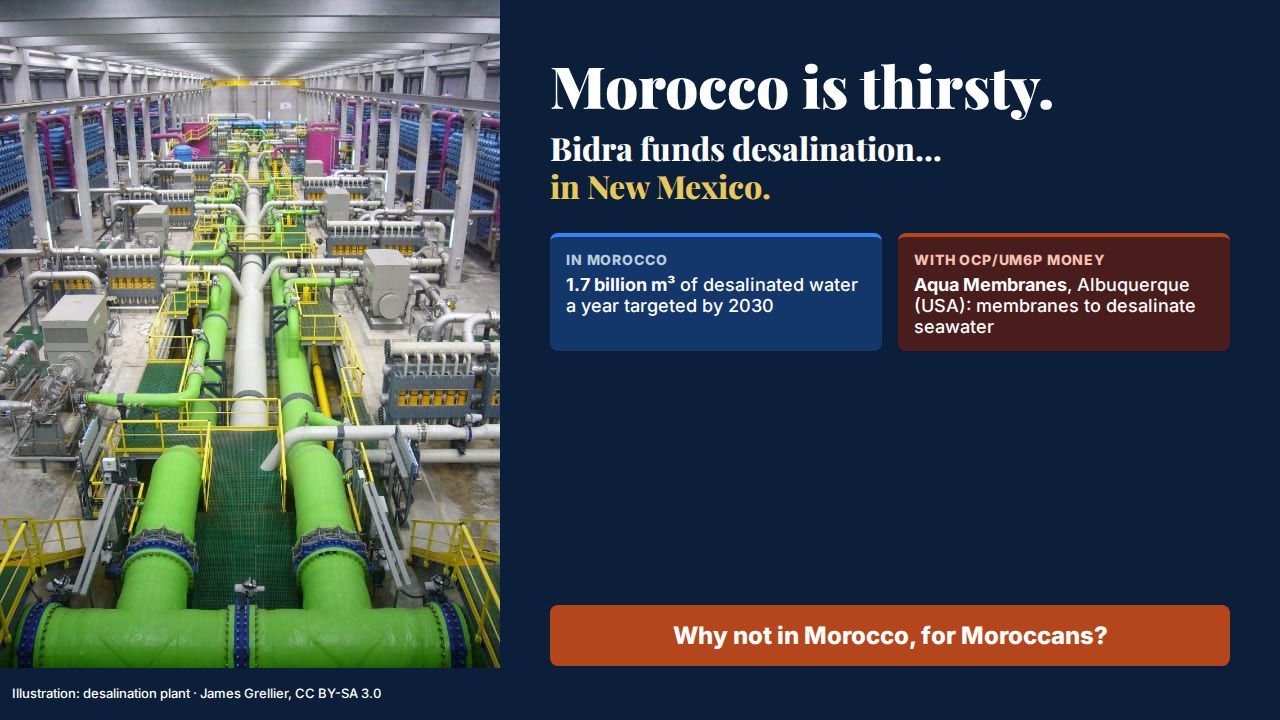
First published in French on 5 October 2026, as part 4 of Jisr.media's investigation into the funding of Mohammed VI Polytechnic University (UM6P), the university created by the OCP Foundation. OCP is Morocco's phosphate and fertiliser group, 94.12% owned by the state. Facts and figures are as of that date.
At the start of this investigation, we showed how money changes the rules it is bound by along the way: it leaves a state-owned company, passes through a public-interest foundation, capitalises a university set up as a public limited company, and then, once inside the UM6P Endowment Holding created by the university itself, funds commercial subsidiaries free of any public-interest obligation. This article follows that path to its most concrete point: a $250 million venture capital fund based in Delaware, the US state known for its discretion in corporate law.
$250 million in Delaware!
Launched in March 2022 with $50 million from OCP and UM6P, Bidra Innovation Ventures received a further $200 million, announced on 5 April 2023 by the fund and its two backers: $250 million in total. The only Form ADV the fund has filed with the Securities and Exchange Commission (SEC), the US regulator, dated 4 April 2023, declares a Delaware fund with a single beneficiary, 100% foreign, and about $52 million in assets. OCP SA’s reference document filed with Morocco’s capital markets authority (AMMC, financial year 2025) confirms it in its own way: Bidra Innovation Ventures Fund, domiciled in the United States, is within the group’s scope of consolidation, under the heading “UM6P ecosystem”, 100% owned. Based in San Francisco, with a second office in New York, Bidra invests in agritech, industry, mining, water and energy: sectors that match, almost point by point, the strategic priorities of the OCP group itself.
Status: limited liability company (LLC) registered in Delaware, offices in San Francisco and New York.
Money received: $50M in March 2022, then $200M in April 2023, i.e. $250M.
Backers: OCP and UM6P, the only identified backers.
In OCP's accounts: 100% consolidated, under "UM6P ecosystem".
Sectors: agritech, industry, mining, water, energy.
The fund’s CEO, Yassine Cherkaoui, makes no secret of it: in public statements, he himself describes Bidra as “the corporate venture capital arm of OCP Group and its affiliated university, UM6P”. A description that has the merit of clarity, and that confirms, in the words of its public face, what the chain of control described at the start of this investigation already suggested.
Who really runs Bidra? Names that don’t match
Bidra’s communications have featured several faces. At launch, Amar Singh, presented as president, from the world of corporate venture capital in agriculture. On the fund’s current website, he is listed only as a “Venture Partner”, an outside associate. Today, Yassine Cherkaoui, CEO, who spent several years at OCP S.A., first as a project officer and then as vice-president for strategy and corporate development. And, on the team, Kevin Zussman, a former head of investments.
A single declared executive: Amardeep Dhaliwal, managing director since February 2022.
His is the only name on the Form ADV filed with the SEC on 4 April 2023. Neither Yassine Cherkaoui nor Kevin Zussman appears. Conversely, the name Amardeep Dhaliwal does not appear on Bidra's website, where "Amar Singh" does. The same filing declares a fund with a single beneficiary, 100% foreign.
According to our sources, Amardeep Dhaliwal and “Amar Singh” are one and the same person. The full name appears on the official filing with the regulator; the short name on press releases, at conferences and on the fund’s website. The fund has never made the link publicly. As a result, a Moroccan citizen trying to find out who manages these $250 million could not connect the executive declared to the US authorities with the person presented to the public, first as president, then as a mere associate. And it remains impossible to know who really decides how this money is used.
Hence a simple question: if the man declared as Bidra’s sole executive, presented to the public as its president, is indeed the same as Amar Singh, now demoted to a mere associate, who legally runs the fund today? Yassine Cherkaoui is the CEO shown on the website. But no document filed with the US regulator names him as an executive: the only filing, from 2023, does not mention him, and none has followed.
Since 31 December 2025, Bidra has no longer been registered with the US regulator.
According to the SEC's official database, the management company's registration is "withdrawn for failure to renew". The last Form ADV dates from April 2023: the $200 million paid in afterwards does not appear in any public filing with the regulator.
Yet Bidra kept investing in 2026, in India (BigHaat, February) and the United States (TerraBlaster, August). So who legally manages these deals, and under what status?
Startups in the United States, India, Kenya, Nigeria, Indonesia… and Morocco?
Where does the money go? The fund publishes no activity report. But it lists its companies and their cities on its own website. We checked it on 4 October 2026: 15 companies, 10 of them in the United States, with typical tickets of $0.5 million to $5 million.
United States: 10 · India: 2 · Kenya: 1 · Nigeria: 1 · Indonesia: 1 · Morocco: 0
According to the portfolio published by Bidra itself on its website, accessed on 4 October 2026.
| Startup | City, country | Activity |
|---|---|---|
| Aqua Membranes | Albuquerque, USA | Membranes for seawater desalination |
| Aclarity | Medway, USA | Destroying “forever chemicals” in water |
| AgroSpheres | Charlottesville, USA | Biopesticides |
| TerraBlaster | San Francisco, USA | Laser soil analysis |
| EarthOptics (merged with Pattern Ag in 2024) | Minneapolis, USA | Soil analysis |
| Travertine | Boulder, USA | Recycling phosphogypsum, a waste product of phosphate fertilisers |
| Tidal Metals | Hamilton, USA | Magnesium extracted from salt water |
| Mitra Chem | Mountain View, USA | Battery materials based on iron and phosphorus |
| Peregrine Hydrogen | Santa Cruz, USA | Hydrogen and sulphuric acid |
| Verdagy | Moss Landing, USA | Electrolysers for green hydrogen |
| BigHaat | Bangalore, India | Agricultural platform: $10M raised in February 2026, round led by Bidra |
| Niqo Robotics | Bengaluru, India | AI-guided spraying robots |
| Apollo Agriculture | Nairobi, Kenya | Credit, inputs and advice for smallholder farmers |
| ThriveAgric | Abuja, Nigeria | Smallholder access to inputs and markets |
| Semaai | Jakarta, Indonesia | Agricultural inputs marketplace and digital advice |
Source: portfolio published on Bidra’s website (bidra.vc), accessed on 4 October 2026; company announcements.
This official portfolio includes no Moroccan startup, even though specialist databases place Bidra in San Francisco and in Benguerir, near the UM6P campus. To measure the gap: UM6P Ventures, the university’s fund dedicated to young Moroccan companies, has about 163 million dirhams in capital, according to 2025 legal notices. Bidra received $250 million, about 2.5 billion dirhams: fifteen times more, invested outside Morocco.
2.5 billion dirhams for startups abroad: fifteen times the fund reserved for Moroccan startups.
These companies are no doubt developing useful technologies, and some serve African farmers. But look at Morocco’s needs. After several years of drought, water has become a national emergency. Agriculture, which supports much of the rural population, needs innovations suited to our soils and climate. Artificial intelligence could help manage irrigation, dams, aquifers and harvests better. These are exactly the sectors Bidra targets: agritech, water, energy. Bidra even funds a seawater desalination technology, while Morocco is building its own desalination plants at great expense: but the startup is based in New Mexico. And our public universities, with up to 69 students per teacher, sorely lack the means for such research.
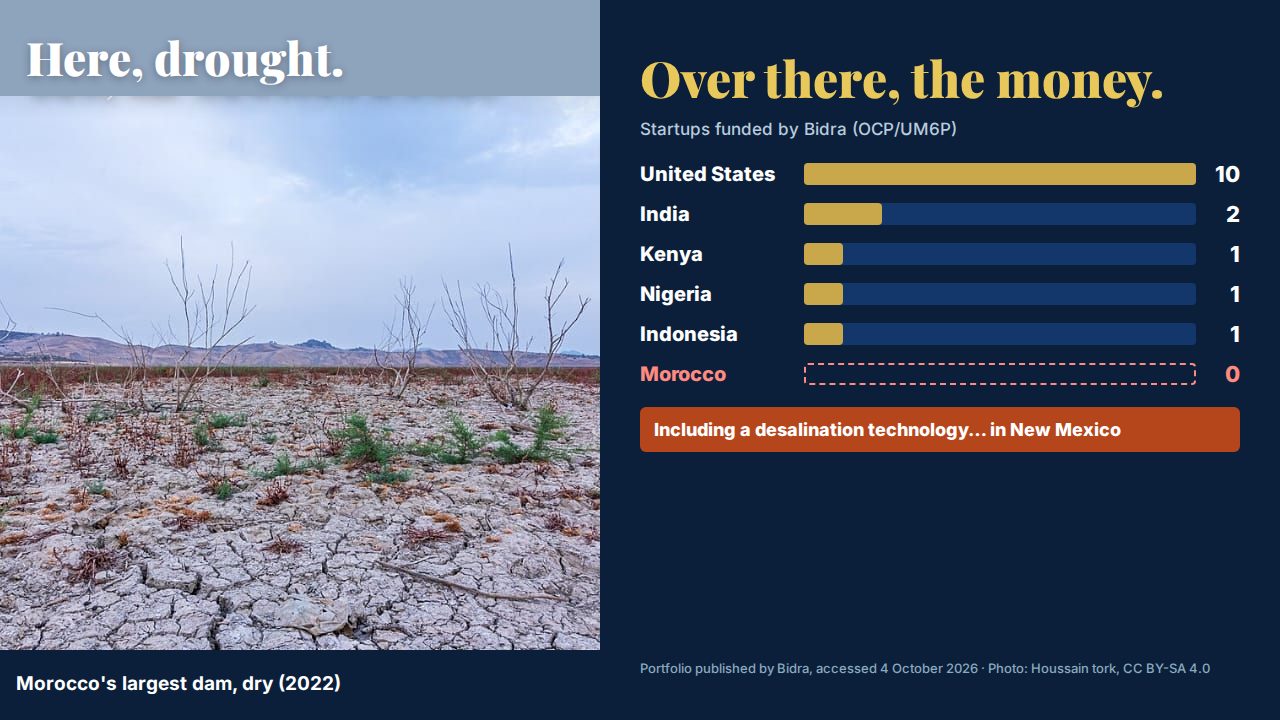
Photo: Houssain tork, Wikimedia Commons, CC BY-SA 4.0. Data: portfolio published by Bidra, accessed on 4 October 2026.
So, for anyone who cares about their country, the question is unavoidable: why look for these solutions in the United States, India, Kenya, Nigeria or Indonesia, rather than first funding researchers and startups working in Morocco, for Moroccans, with money from a group 94% owned by the state?
Why Delaware, the champion of discretion?
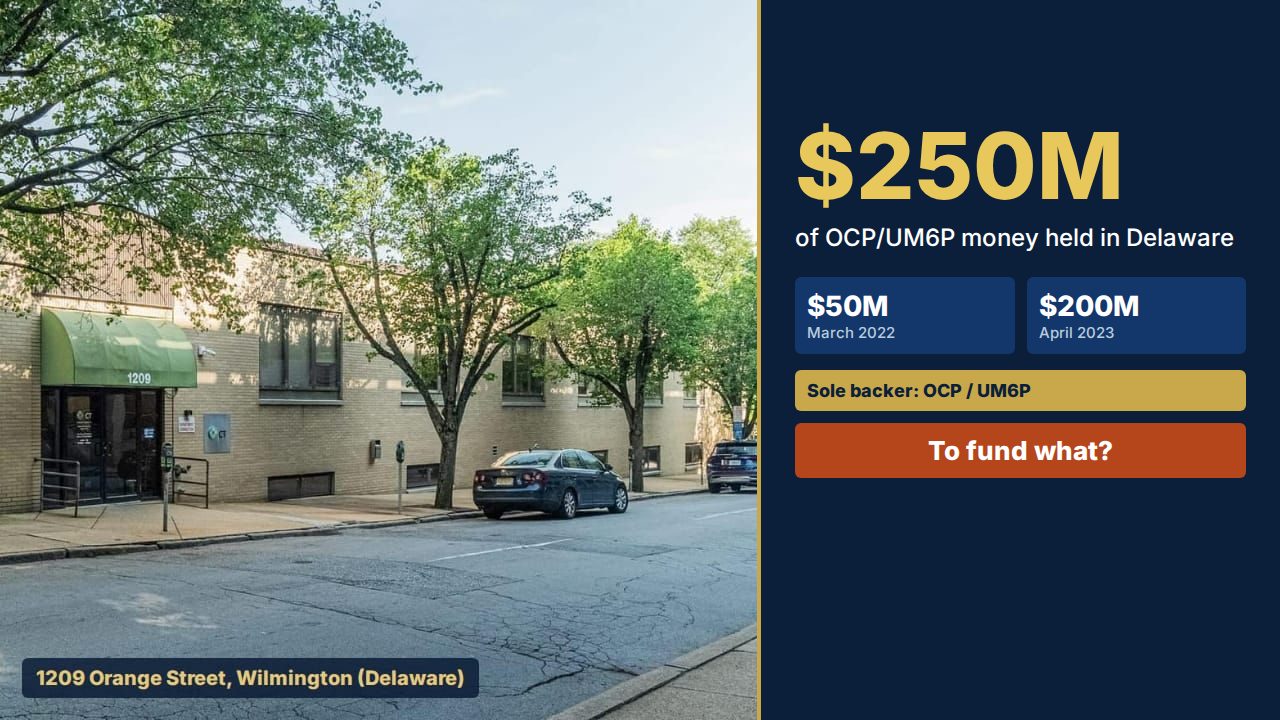
Offices of Corporation Trust Company, 1209 North Orange Street, Wilmington (Delaware), registered agent of Bidra Innovation Ventures. Photo: Philtoss, Wikimedia Commons, CC0.
Bidra’s choice of jurisdiction is nothing unusual. Its registered agent is the Corporation Trust Company, at 1209 Orange Street in Wilmington: the most widely used registered-agent address in the world, home to hundreds of thousands of companies. That choice alone says nothing about who the fund’s beneficial owners are. Delaware does not require an LLC to disclose its managers publicly at formation, unlike Canada’s federal registry or, to a lesser extent, French registries.
In Delaware, an LLC publishes almost nothing.
No public list of members or managers. No annual accounts to file. No public annual report: a flat annual tax is enough. As a result, to know what Bidra invests in, how much it earns or loses, and who decides, one has to rely on what the fund chooses to say, and on rare federal documents such as the Form ADV.
This choice is not illegal, and many US funds make it. But for a fund financed with money from a Moroccan public group, it keeps the essential information out of public reach: what becomes of these $250 million.
From the first part to the last: zero answers!
Jisr.media asked OCP to confirm the amounts and exact dates of these two investments, to specify whether the money came from UM6P’s “research and innovation” budget, from the university’s capital or from another OCP Foundation budget line, and what evaluation and monitoring criteria apply to this investment, and by which body. This request was part of the right-of-reply letter sent on 13 September 2026 to Khalid Baddou, then chief of staff to UM6P’s presidency and appointed on 25 September as managing director of UM6P Hospitals. The deadline was 21 September.
Zero answers.
Neither to our letter of 13 September 2026, nor since the publication of the first three parts.
Not on the budget origin of the $250 million, nor on the oversight mechanisms, nor on the division of authority between the public CEO and the sole executive declared to the US regulator; nor, more broadly, on any of the points raised in this investigation: governance concentrated around the same names, UM6P’s role in Morocco’s national research programme PNARDI, the 14 billion dirhams spent on campuses and the cost of international branches, and this venture capital fund based in Delaware.
A state within the state?
OCP has long been described as “a state within the state”. At the end of this series, official documents describe a group that funds, owns, evaluates and invests, from Morocco to Delaware, with the same leaders in key positions, six ministers around the table, and without publishing detailed public accounts. The phrase has never seemed so apt. It is now up to officials, and elected representatives, to answer the questions.
The investigation continues: the difficult questions
- Which budget line did the $250 million come from: the university’s capital, its research budget, the OCP Foundation?
- Who really decides Bidra’s investments: its CEO, Yassine Cherkaoui, or Amardeep Dhaliwal, also known as Amar Singh, the only executive declared to the SEC? Why present two different names for the same person to the public and to the regulator? And if he has been demoted to a mere associate, who legally runs Bidra today?
- Why has Bidra not been registered with the US regulator since the end of 2025?
- Which companies has Bidra invested in, and with what results?
- Why is there no Moroccan startup in Bidra’s official portfolio, when the fund is presented as also based in Benguerir?
- Why base in Delaware a fund financed with money of Moroccan public origin?
- What oversight mechanisms apply to this investment, and by which body?
CALL FOR TESTIMONIES
Do you work, or have you worked, at OCP, UM6P or their subsidiaries? Do you have information about this story? Write to us at [email protected].
Anonymity guaranteed, sources protected. Your identity remains confidential: we publish nothing that could identify you, and we check with you any passages based on your testimony before publication.
The investigation continues. We are still waiting for answers from OCP and UM6P officials, and we will publish any reply we receive. Because this is ultimately about public money (the Moroccan state holds 94.12% of OCP SA’s capital), Jisr.media will hand this file to the newly elected members of Morocco’s House of Representatives, so that they can, if they see fit, put these questions to the government.
Also on Jisr.media:
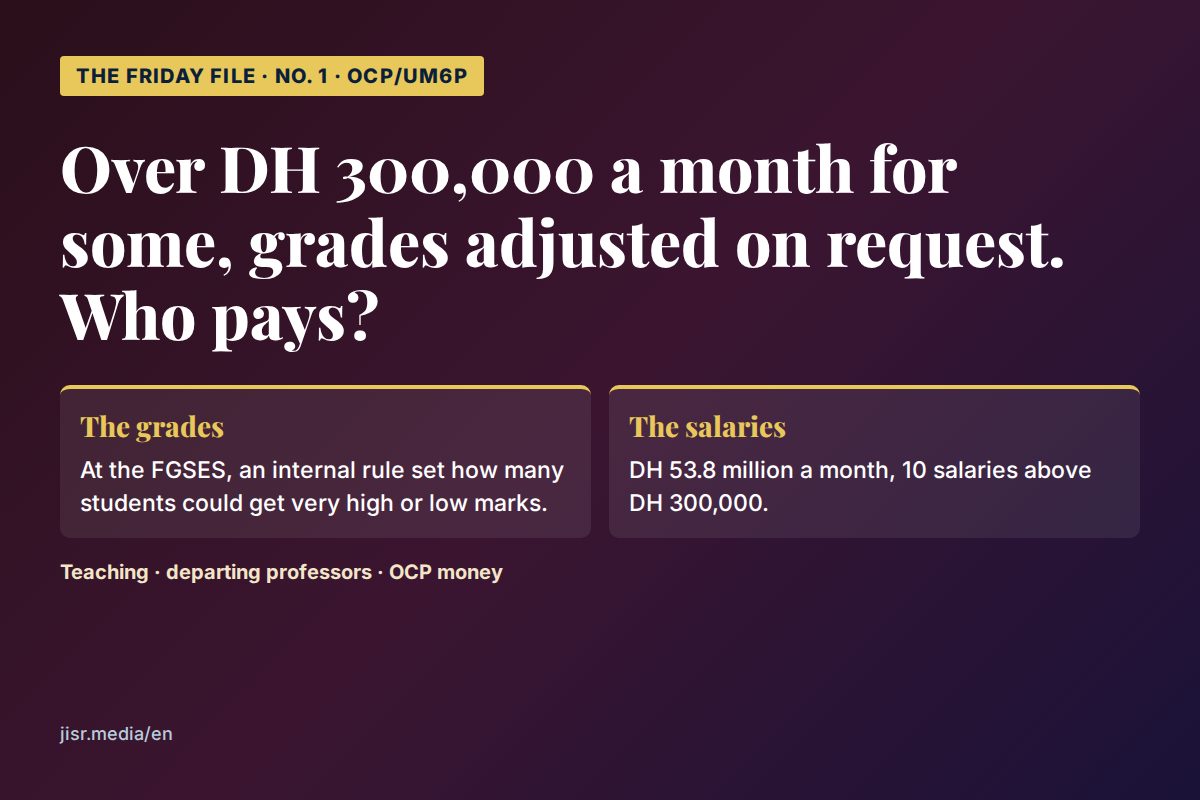
- UM6P: over DH 300,000 a month for some, grades adjusted on request. Who pays?
- The original version of this article in French · and in Arabic
- The full OCP/UM6P series (in French)
FAQ
How much did OCP/UM6P invest in Bidra Innovation Ventures?
$250 million in total: $50 million in March 2022, then $200 million announced in April 2023. The only Form ADV filed with the SEC, on 4 April 2023, still declared just $52 million in assets.
Where is Bidra Innovation Ventures registered?
It is a Delaware LLC with offices in San Francisco and New York; its registered agent is the Corporation Trust Company, 1209 Orange Street, Wilmington. Delaware law does not require an LLC to publish its managers.
Who runs Bidra Innovation Ventures?
The website shows Yassine Cherkaoui as CEO and Amar Singh as Venture Partner; the SEC filing declares only Amardeep Dhaliwal, who according to our sources is the same person as Amar Singh.
Which sectors does Bidra invest in?
Agritech, industry, mining, water and energy: sectors that overlap with OCP’s own priorities.
Has OCP explained where the $250 million came from?
No. Our questions on the budget origin and oversight of this investment have gone unanswered.